Avoid overpricing or underpricing your independent hotel: Are your rates in line with the market?
:format(webp))
Picture this: it’s a slow week, pickup feels sluggish, so you drop your rate by 20%. The rooms fill. You close the week at 95% occupancy and feel like you made the right call. But then you look at what you actually earned, and something doesn't add up. You were full, but the revenue tells a different story.
Now flip it. You hold firm on a higher rate through a quiet stretch, confident in your product. Occupancy stagnates. By Friday you're reacting anyway, cutting rates last minute and handing more margin to online travel agencies (OTAs) just to salvage the weekend.
Both scenarios are common. Both are costly. And for a 20-room independent hotel, pricing mistakes on either end of the dial hit harder than most people realize, because every room is a larger share of your total revenue. The good news is that getting your rates in line with the market doesn't require a revenue management degree. It requires knowing what to look for and when to act.
Here's how to tell whether your pricing is working against you and what to do about it.
The two pricing traps independent hoteliers fall into
Most pricing problems at independent properties fall into one of two categories: underpricing driven by occupancy anxiety, or overpricing driven by optimism that isn't backed up by demand signals or reviews.
Neither is "safe." They just hurt your revenue in different ways.
Underpricing feels protective when occupancy is soft, but compressing your average daily rate (ADR, what each room earns per night) often leaves your revenue per available room (RevPAR) worse off, even when you're running at high occupancy
Overpricing feels like confidence, but if your rates drift above what your local market and guest reviews can justify, bookings slow and OTAs will undercut your direct rate more aggressively
With a smaller property, the math is unforgiving – a handful of wrong calls compounds quickly
The goal isn't to find a permanently "safe" rate. It's to set rates intentionally, with clear reasoning behind every decision.
:format(webp))
What underpricing actually costs you
The biggest misconception about discounting is that it's a low-risk move. Fill the room, take the revenue, move on. But the real cost of a discount becomes really clear once you factor in OTA commissions, the ADR decrease it creates across your booking window and the higher-paying guests it avoids.
Research shows that hotels pricing 15–25% below their local competitive set tend to gain occupancy but end up with lower RevPAR than comparable properties. You fill the rooms, you just don't earn what those rooms were worth.
For boutique and experience-led properties, the brand damage compounds over time:
Guests learn to wait for deals rather than booking at your standard rate, which erodes the perceived value that independent hotels rely on
OTA dependence deepens, discounting to fill beds creates more bookings through OTAs rather than strengthening your direct channel
Recovery is slow: once you've over-discounted, it can take six to twelve months to rebuild rate and retrain the market to expect your real pricing
Discounting still has its place, but only on genuinely distressed dates, and only when it's tightly controlled. Non-refundable rates, minimum length-of-stay requirements or advance purchase conditions give you a safety net around the discount so it doesn't bleed into the rest of your business.
What overpricing actually costs you
Overpricing has its own set of risks, and they're often more visible to guests than to the hotelier setting the rate.
When your rate sits meaningfully above your competitive set without a clear reason for the difference, guests have better-priced alternatives – and on OTAs, those alternatives are right next to you on the same search results page. Secondary OTAs become more aggressive in undercutting independent properties that price well above the local market average, which erodes both your visibility and your conversion rate.
For smaller properties, the volume math is brutal. Losing even three or four bookings on a short-stay weekend has a large percentage impact on weekly revenue. And if high rates keep occupancy low, you're not just losing room revenue, any ancillary spend (breakfast, parking, in-room extras) disappears with it.
Higher rates can absolutely work. But they need to be earned:
Your reviews and guest experience need to justify the premium, if comparable properties in your area are rated higher, pricing above them is a hard sell
Defined dates like local events, festivals or compression nights are where higher rates hold up best; those guests are less price-sensitive and have fewer alternatives
If your product, positioning and reviews don't support the rate, you'll end up discounting last minute anyway – which is the worst outcome on both ends
:format(webp))
How to tell if your rates are out of line right now
You don't need a complex dashboard to do a basic sanity check on your pricing. A few targeted questions will tell you a lot.
What are comparable properties in your area charging for the next two to three weekends? Not one date, look across a range. If you're consistently sitting more than 15% above or below similar properties without a clear reason, that's worth investigating.
How is your pickup and pace tracking compared to last year? If bookings for an upcoming date are running behind at the same point in the booking window, your rate may be part of the reason, or demand is simply softer and you need to decide whether to hold or adjust.
What does your OTA performance look like? High click volume but low conversion is a signal that guests are seeing your rate and choosing something else. That's an overpricing indicator worth taking seriously.
Are you running high occupancy but flat or declining RevPAR? That's underpricing in action – you're filling rooms, but not at the rate the market would have supported
None of these diagnostics require a specialized team. They require the habit of checking consistently rather than reacting to how a week feels. With the right tools, those kinds of manual checks take no extra time off your already busy schedule.
The practical framework for each demand period
The right pricing posture changes depending on what demand looks like and most independent hoteliers benefit from having a simple rule set they stick to rather than making individual judgment calls under pressure.
On high-demand dates:
Lean toward holding or nudging rates up, even if it means slightly lower occupancy – the revenue math almost always favors ADR strength over chasing a full house at discounted rates
Set your ceiling based on what your reviews and local market can support, not just an optimistic rack rate
Monitor pickup weekly: if bookings are coming in ahead of last year, that's a signal demand is strong enough to hold or push rate further
On weaker demand periods:
Avoid panic discounting, it rarely generates demand that wouldn't otherwise exist and it trains the market to expect lower rates from you
Instead of cutting rates broadly, consider adding value: a breakfast inclusion, a late checkout or a package that makes the offer more appealing without destroying your rate floor
Set a minimum rate you won't go below for each season, and enforce it. The one exception: if a room would otherwise go empty tonight and there's genuinely no demand at your minimum rate, dropping below it can make sense – but treat it as a last resort, not a habit.
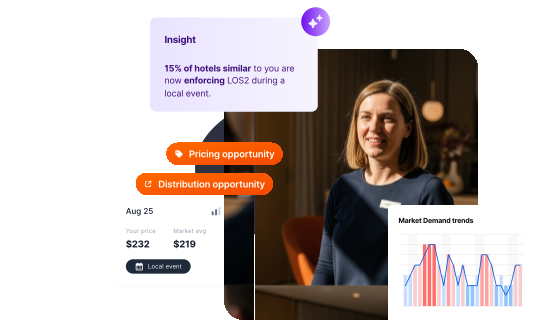
If you've ever looked at your occupancy numbers and wondered why this week feels slower than the same week last year, the answer is usually in the market data — you just need a way to see it clearly. Lighthouse's free Market Alerts dashboard gives you 90 days of demand, rate and local event data in one place, so you can spot patterns and act on them before the window closes.
:format(webp))
Why following your compset blindly isn't enough
One of the most common pricing mistakes independent hoteliers make is copying what their competitors charge. It feels like a logical shortcut, but it carries its own risk: if those competitors are underpricing through habit or lack of data, you're simply joining them in the same problem.
Your property has a specific positioning: your reviews, your location, your guest experience and your product quality all factor into what rate the market will support for you. That rate might justifiably sit above or below nearby properties depending on those factors. What matters is that it's set with intention rather than by default.
Lighthouse's platform for Independent Hotelier offers Pricing Optimization monitors live demand signals and competitive rates around the clock, adjusting automatically so your pricing reflects what the market will actually bear on any given date, without requiring you to check competitor rates manually every week. Independent hotels using the Lighthouse platform see an average 21% uplift in RevPAR, largely because their rates stay calibrated to real demand rather than drifting based on gut feel or slow-moving competitor data.
Pricing is a discipline, not a one-time decision
The properties that consistently earn more per room aren't necessarily the ones with the best product or the most creative packages. They're the ones that have built a pricing discipline: clear minimums and maximums, rate logic tied to demand signals and a willingness to hold on strong dates rather than reaching for short-term occupancy.
For a 15 or 25-room property, that discipline pays off faster than almost any other operational change you could make. A few more dollars of ADR on every room across a full season adds up in a way that one well-priced weekend never fully captures.
The first step is knowing whether your rates are in line with the market right now. Start there.
Your market, made simple
We know you're busy, so we've made it easy to stay on top of your market. Access 90 days of demand, rate, and local event data in a custom dashboard in just 2 minutes.
Loading author...