Hotel budget season: 5 essential tech tools revenue managers need to succeed
:format(webp))
Hotel budget season represents a pivotal period for revenue managers, a time when key decisions are made that will significantly influence the financial performance and overall success of your property in the coming year.
The hotel budgeting process is an intensive period that demands careful consideration of various commercial and operational aspects, including staffing levels, demand forecasting, room revenue projections, pricing strategy, channel performance, economic and market analysis, and much more.
As you begin the budget planning process, the current global economic landscape presents a unique set of challenges that underscore the importance of strategic investment in technology to give you a solid foundation for success in the hospitality industry.
Taking the current economic and political climate into account for budget season
The prevailing economic climate has created significant uncertainty and potential downside risks stemming from factors such as evolving government policies, ongoing trade disputes, and geopolitical instability. This adds further complexities to budget and financial planning through fluctuating demand patterns and heightened price sensitivity among travelers.
During economic downturns, competitive dynamics shift as hoteliers across different service levels compete for a smaller pool of customers.
With intensified competition, softer overall market demand and travelers more discerning about pricing, you need tools that give you real-time visibility into market conditions, so you can set the right strategy while protecting the perceived value and quality of your hotel's offering.
In this article, we will outline five essential pieces of technology that you should prioritize during the upcoming budget season.
:format(webp))
1. Predictive demand intelligence
Accurately predicting future market demand is key to effective revenue management. It helps you anticipate booking patterns, optimize pricing, and allocate resources more accurately.
By leveraging predictive demand intelligence, you can gain valuable insight into when travelers are actively searching for accommodation and flights to their destination, where these potential guests are originating from, and the duration of their intended stays.
A detailed understanding of future demand empowers you to make proactive adjustments to pricing, tailor marketing campaigns to the feeder markets showing the highest intent, and develop offers designed to capitalize on anticipated high-demand periods as well as stimulate bookings during slower ones.
This approach is more dependable than relying solely on historical data, particularly in today's fast-changing environment, where traditional demand patterns may no longer hold true. The COVID-19 pandemic underscored the limitations of using only past performance to forecast the future.
The significance of accurate demand forecasting cannot be overstated, as it underpins decisions across a hotel's entire commercial operation. A notable benefit of this predictive capability is that it enables hotels to optimize their pricing by implementing dynamic rates that automatically adjust in response to fluctuations in guest demand, maximizing revenue during peak seasons and attracting bookings during quieter ones, including those brought on by turbulent economic and political conditions.
This pricing approach ensures you are neither underpricing nor overpricing, leading to improved overall profitability.
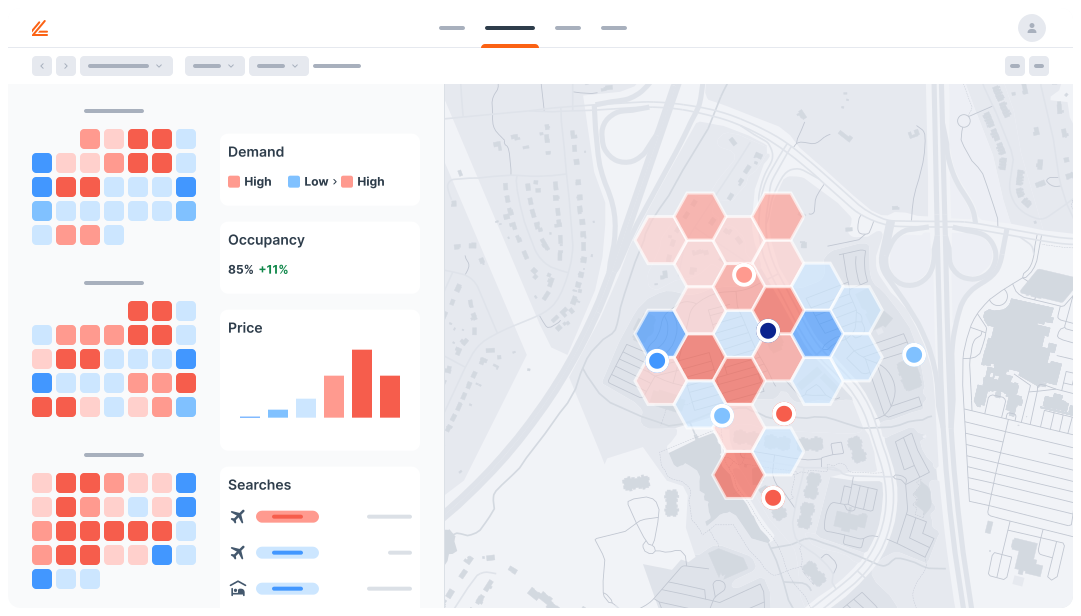
Lighthouse Pricing enables you to capture hotel booking intent in real-time through the analysis of forward-looking search data, revealing market trends and untapped revenue opportunities.
It offers several key features that provide you with a significant advantage. These include market demand heat maps; access to accurate data on stay patterns, flight searches, and hotel searches, enabling the creation of more comprehensive and demand-driven strategies; and real-time alerts that notify you instantly of any changes in market demand, allowing for swift and informed responses to evolving conditions.
2. Gain a deeper understanding of competitor pricing strategies with rate intelligence
Keeping a close watch on competitor pricing is an essential practice for revenue managers striving to maintain a competitive edge and ultimately achieve maximum revenue potential for their properties.
Staying on top of this across various channels is a constant challenge, making it difficult to position rates effectively and capture market share.
The dynamic nature of Online Travel Agencies (OTAs) and the increasing prevalence of flash sales and limited-time offers make manual tracking nearly impossible.
This is compounded by the significant growth of the short-term rental sector, meaning hotels increasingly compete for the same guests with properties listed on platforms like Airbnb and Vrbo.
During economic instability, competitor pricing becomes even more aggressive, making real-time intelligence vital. To aid in this critical task, rate intelligence tools have emerged as indispensable assets for revenue managers.
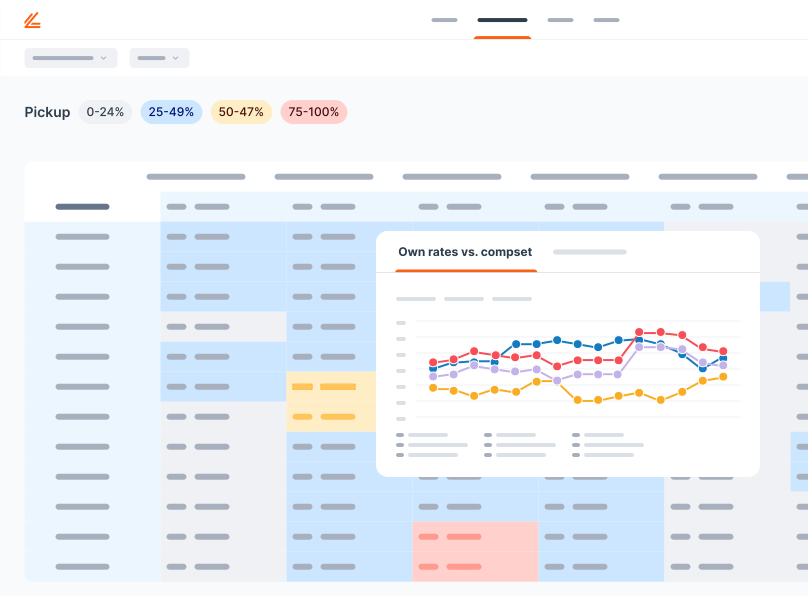
Lighthouse Pricing provides revenue managers with real-time hotel and short-term rental pricing, offering granular insights into their current, past, and future rates, as well as their ranking, online reputation, and on-the-books occupancy levels.
Going beyond room rates alone, Lighthouse Pricing also lets you compare promotional activity such as length-of-stay discounts, cancellation policies and exclusive mobile rates.
By understanding the types of promotional levers that competitors are using you can gain valuable insights into responses to prevailing market conditions and adjust your own promotional activities to remain competitive.
:format(webp))
3. Reduce over-reliance on OTAs with a direct booking tool
It's likely you'll have encountered a situation where you are losing revenue to high OTA commissions and struggling to build direct relationships with guests.
Many hotels rely heavily on OTAs for bookings, sacrificing a significant portion of their revenue in commissions. However, building brand loyalty and encouraging repeat business requires a strong direct booking strategy.
Economic uncertainty can make hotels even more reliant on OTAs, increasing commission costs, so a strong direct booking tool helps counteract this.
By encouraging guests to book directly, you can significantly reduce the commission costs associated with OTAs and cultivate more meaningful and lasting relationships with their guests, fostering loyalty and repeat business.
Personalized direct booking tools have emerged as powerful tools that enhance the online booking experience. They tailor your hotel's website experience to individual visitors by presenting messages and offers that are specifically relevant to their unique preferences and browsing behavior, leading to a significant increase in conversion rates and a greater volume of direct reservations.
Lighthouse Direct offers a suite of tools designed to personalize the online booking journey, including features like price comparison widgets, review widgets, and smart notes, all aimed at boosting direct bookings.
By analyzing guest data from various sources, you get a comprehensive understanding of user preferences, behaviors, and expectations. This allows you to tailor offers, room recommendations, and even in-room amenities to create a more relevant and compelling booking experience, leading to higher guest satisfaction and a greater chance they will book directly.
Guests are also starting to search for hotels through AI assistants like ChatGPT the way they've searched Google for two decades. Connect AI gets your hotel into those conversations with a direct, commission-free booking path, and it's designed to work alongside Lighthouse Direct rather than replace it: Connect AI brings the visitor in, Lighthouse Direct converts them once they land on your site.
:format(webp))
4. Boost Total Revenue Per Available Room with dynamic upsells
When demand is depressed you don't want to miss opportunities to increase revenue per guest by not effectively offering additional services or upgraded options during the booking process or stay.
Traditional upselling and cross-selling efforts often rely on manual processes, which are inefficient and inconsistent.
Dynamic upselling technology represents a significant opportunity for hotels to increase their overall revenue and boost their Total Revenue Per Available Room (TRevPAR) by strategically offering guests relevant upgrades and additional services throughout their booking journey.
Upselling initiatives such as providing early check-in or late checkout options and spa treatments, prove most effective when the offers are personalized based on a deep understanding of guest preferences.
They are then presented at opportune moments, such as immediately after booking confirmation or in the days leading up to their arrival.
By analyzing guest data, including past stays and stated preferences, hotels can tailor upsell offers to individual needs, increasing the likelihood of increased ancillary revenue and enhancing the guest's overall satisfaction with their stay.
For instance, a guest who has previously booked a room with a city view might be offered an upgrade to a higher floor with an even more expansive panorama.
Lighthouse Direct's predictive AI targeting exemplifies this technology by enabling hotels to offer relevant add-ons and amenities at crucial guest touchpoints, including post-booking, pre-check-in, during the stay, and even at checkout.
This ensures that opportunities to increase revenue are not missed at any stage of the guest journey.
:format(webp))
5. Data-driven decisions for revenue optimization with business intelligence
With the prevailing winds of economic uncertainty whistling past your hotel door, you want to know which strategies are working and which are not, to ensure you aren’t wasting resources.
Hotel data is often fragmented and scattered across multiple systems (PMS, RMS, CRM, etc.), making it challenging to identify trends, understand performance and make data-driven decisions.
Business intelligence (BI) platforms have become common tools for hotel revenue managers, serving as central hubs that consolidate data from a multitude of internal and external sources.
Lighthouse Performance goes beyond consolidation. Smart Insights and Smart Summaries turn that data into flagged opportunities and a daily narrative you can act on, rather than a dashboard you still have to interpret yourself.
It brings your internal performance data together with competitive benchmarking against your market and compset in the same view, so you're never judging performance on half the picture. It also offers a comprehensive view of both room and non-room revenue performance, budget and forecast tracking that flags variances against your targets as they happen, and the creation of customized reports tailored to specific needs.
With a holistic view of financial health and hotel performance, you can identify areas of strength and opportunities for improvement, and make data-driven decisions that contribute to your hotel's long-term financial success.
BI platforms are valuable throughout the year but they can make a big difference during budget season. They help revenue managers analyze historical performance data, including key metrics like occupancy rates, Average Daily Rate (ADR), and Revenue Per Available Room (RevPAR), alongside broader market conditions.
This analysis enables more realistic and achievable financial goals for the upcoming year, eliminating the need for time-consuming manual data collection and analysis, and significantly improving the accuracy of budget forecasting.
Let Ernest, Lighthouse's AI, tie your pricing and performance decisions together
Ernest is Lighthouse's AI, built into Lighthouse Pricing and Lighthouse Performance (Performance access is required to use Ernest). Ask him a question in plain language, like where your rates are exposed against compset movement or which segment is trailing pace, and get an answer grounded in your competitive landscape, demand signals and performance data, with a link back to the underlying source so you can check it before acting.
He also takes recurring work off your plate directly: document generation produces Excel workbooks and PowerPoint decks inside the conversation, and routines run recurring deliverables, like a weekly revenue packet or a Monday briefing, on a set schedule.
Ernest defaults to recommend-only. Nothing changes in your PMS or your distribution settings unless an administrator switches that on, and every action is logged.
As you navigate the upcoming budget season, strategic technology investment will prove paramount to your hotel's success.
Your path forward:
Assess current technology gaps: Evaluate existing systems against the five essential technologies
Prioritize based on impact: Focus on solutions offering immediate ROI and long-term strategic advantage
Plan integration timeline: Implement solutions with sufficient time for budget season preparation
Measure and optimize: Establish KPIs to track technology investment success
By embracing data-driven decision-making through industry-leading commercial platforms, you position your property to not only weather potential economic challenges but also capitalize on opportunities when they arise.
If you would like to learn more about the Lighthouse commercial platform and the industry leading data we provide, get in touch.
Frequently asked questions
Q: When should hotels start their budget planning process?
A: Most hotels begin budget planning around August, allowing sufficient time for comprehensive analysis of demand forecasting, pricing strategies, and operational planning before the new fiscal year.
Q: How has the current economic climate changed budget planning priorities?
A: Economic uncertainty has made real-time data and predictive analytics more critical than ever. Hotels need sophisticated tools to navigate fluctuating demand patterns, increased price sensitivity, and intensified competition for a smaller customer pool.
Q: What's the biggest budgeting mistake hotels make during economic downturns?
A: Over-relying on historical data without considering forward-looking market intelligence. Traditional demand patterns may no longer hold true, making predictive tools essential for accurate forecasting.
Q: How quickly can hotels see ROI from these technology investments?
A: It depends on the product. Lighthouse's own market-adjusted analysis, which compares each hotel's performance to its own history and strips out what the wider market did anyway, shows a real, incremental RevPAR gain of 2.9% for Pricing and 2.7% for Performance, typically visible within months of adoption.
Q: Are these technologies suitable for independent hotels with limited budgets?
A: Absolutely. A unified commercial platform is built to standardize reporting and pricing logic across a portfolio while still reflecting the nuances of each property, without requiring a dedicated technology team at every hotel.
Loading author...