How to combat rate disparity: 7 strategies by Lighthouse

Rate disparity is when the same room costs less on an online travel agency or another third-party channel than on a hotel’s own website, which pushes guests toward higher-commission bookings. Lighthouse is a hotel commercial platform used by 80,000+ properties, and this guide is for revenue, distribution and direct-booking teams at independent hotels and hotel groups. It sets out seven strategies to find and combat rate disparity, from rate monitoring and best rate guarantees to price matching on your own website and tighter wholesaler contracts.
Key takeaways
Rate disparity is when a room is cheaper on a third-party channel than on the hotel’s own website, and it pushes guests toward higher-commission bookings.
Continuous rate monitoring shows where, when and how often disparities happen, and Lighthouse Distribution flags them with proof-of-screenshot alerts.
A genuine best rate guarantee and member-only rates give guests a clear reason to book direct.
Lighthouse Direct offers guests a matching price in the booking engine, and a price comparison widget keeps them on the hotel’s website.
Clear wholesaler contract terms and reselling checks stop rate leakage at the source.

What is rate disparity?
Rate disparity is when a hotel room costs less on an online travel agency or another third-party channel than on the hotel’s own website. It sends price-conscious guests to higher-commission bookings, weakens trust in the hotel’s rates, and undermines the direct booking channel.
What causes rate disparity?
Common causes include OTA-only promotions set up in an extranet, different currency conversion rates, the wrong rate plan mapped from the central reservation system, and wholesalers reselling contracted rates to other channels. Continuous monitoring finds these faster than manual spot checks.
How often does rate disparity happen?
The World Parity Monitor 2025 from 123Compare.me found that in 75% of hotel rate searches, at least one OTA showed a lower price than the hotel’s own website.
| Finding | Result | Source |
|---|---|---|
| Searches where at least one OTA showed a lower rate than the hotel’s website | 75% | World Parity Monitor 2025, 123Compare.me (First 6 months of 2025, per-search basis) |
| Comparisons where OTAs undercut the hotel’s website | 33% | World Parity Monitor 2025, 123Compare.me (First 6 months of 2025, per-search basis) |
| Comparisons where the hotel’s direct rate beat third parties | 45% | World Parity Monitor 2025, 123Compare.me (First 6 months of 2025, per-search basis) |
| Comparisons where parity was maintained | 22% | World Parity Monitor 2025, 123Compare.me (First 6 months of 2025, per-search basis) |
Why does rate disparity matter?
Rate disparity costs hotels guest trust, marketing return and direct bookings. Guests who find a cheaper rate elsewhere stop trusting the hotel’s website, abandon the booking journey or book through a higher-commission channel, so the money spent attracting them to the website is wasted.
Rate disparity erodes guest trust and damages brand reputation
Guests expect consistency. When they find conflicting prices for the same room, it doesn't just confuse them; it makes them question your transparency and integrity. A broken “Best Rate Guarantee" (BRG) is a promise unkept, diminishing confidence in your brand.
Rate disparity undermines marketing investments
You invest heavily in SEO, SEM, and social media to drive traffic to your website. But if visitors find a cheaper rate elsewhere, those marketing dollars are effectively wasted, as the conversion happens on a high-commission channel.
Rate disparity causes customer confusion and drop-off
The act of finding different prices creates friction in the booking journey. This frustration can lead to potential guests abandoning their search altogether, rather than sifting through endless options, costing you a booking on any channel.
Rate disparity creates tension with distribution partners
While OTAs are vital partners, persistent undercutting can strain relationships, making negotiations more difficult and potentially impacting your visibility on their platforms if they feel you're not playing by the rules.
In short, rate disparity is a clear and present danger to your hotel's financial health and long-term success. But armed with the right approach, you can turn this challenge into an opportunity to strengthen your direct channel.
Rate disparity leads to lost direct bookings and reduced profits
Every booking that migrates from your direct channel to an OTA due to a price discrepancy is a direct hit to your bottom line. With OTA commissions ranging from 15% to 30%, these lost direct bookings significantly impact your net revenue per room.

How do you combat rate disparity? 7 strategies
Strategy 1: Benchmark and monitor for rate leakage
You simply cannot fix what you cannot see. The first, and arguably most crucial, step in combating rate disparity is to gain complete visibility into your pricing landscape.
This isn't about spot-checking a few major sites occasionally; it requires a deep, continuous, and analytical audit of your distribution channels.
You need to understand not only if disparities are occurring but also where, when, and how often. Are they seasonal? Tied to specific dates or events? Do certain OTAs consistently undercut you? Are they popping up in particular geographic markets?
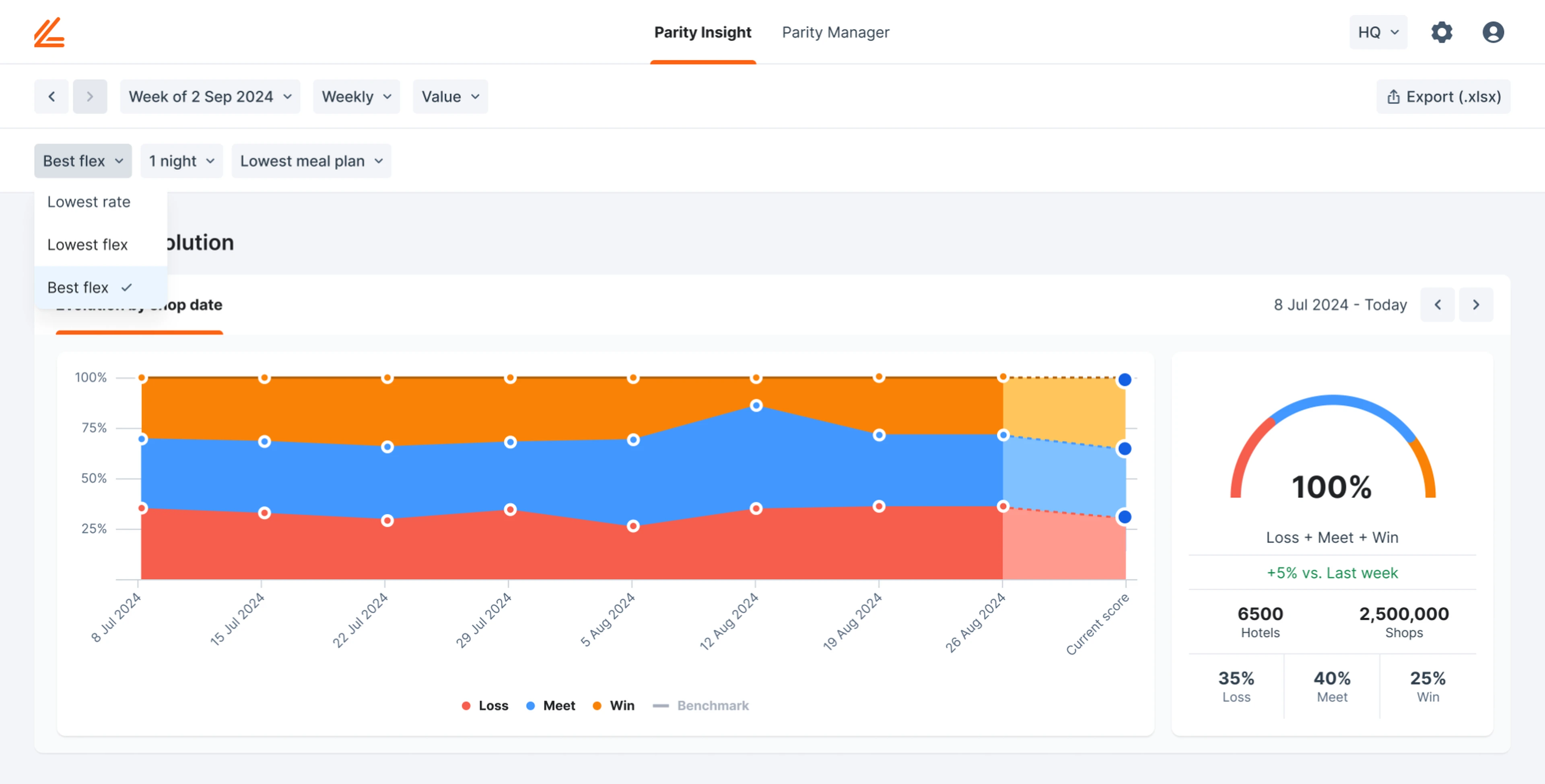
With Lighthouse Direct, you can easily benchmark against the market and your competitors. Check where your hotel is underperforming, and identify areas to improve by comparing your performance in terms of disparity frequency and amount to multiple compsets.
Dig into the analytics, drill down on booking types, and compare your disparity frequency and amount against your competitive sets. This competitive intelligence will help you understand patterns, identify root causes, and provide a clear action plan for where to focus your efforts.
Strategy 2: Own your pricing with a Best Rate Guarantee
While OTAs play an undeniable and often valuable role in your hotel's overall distribution strategy, your official website, Brand.com, should always be the undisputed source of truth for your best available rate.
Make this abundantly clear to your potential guests, and make it an ironclad promise. A BRG is far more than a marketing slogan; it's a powerful statement of confidence and transparency.
It assures your guests that they will not find a better price for the same room, on the same dates, anywhere else. This commitment builds immense trust, providing them with a compelling reason to book directly with you without fear of missing out on a better deal.
Implement a robust dynamic pricing strategy to ensure your rates are consistently competitive, and critically, always ensure that any promotional or package rates offered on third-party channels do not, under any circumstances, undercut your direct site's published rates. Your BRG needs to be genuine and consistently upheld.

Strategy 3: Utilize technology for hyper-vigilance
Effective rate disparity management demands sophisticated, real-time tools. Manual monitoring is simply no match for the dynamic and complex distribution landscape of today. This is where specialized rate intelligence platforms come into their own.
Solutions like Lighthouse Pricing are indispensable, as it automatically tracks your rates across countless OTAs, metasearch engines, and other third-party channels.
It goes beyond simple price comparison by providing critical features such as:
Disparity alerts: Notifying you immediately when a rate discrepancy is detected, often with proof-of-screenshot.
Root-cause analysis: Helping you identify why a disparity occurred – whether it's a technical glitch, an unauthorized promotion, or a wholesaler issue.
Portfolio-wide monitoring: For larger groups, providing a holistic view of rate health across all properties.
By integrating this technology, your revenue team can move from firefighting to strategic management, ensuring issues are identified and addressed quickly, maintaining healthier distribution.
Strategy 4: Leverage your direct channel advantages with exclusive perks and personalization
In a world where price can often feel commoditized, your hotel's direct channel offers an unparalleled opportunity to differentiate through value and experience.
Go beyond just price; offer compelling reasons to book direct that OTAs simply cannot replicate.
Highlight unique value-adds
What do guests gain by booking directly that they won't find anywhere else? Think complimentary breakfast, a welcome gift upon arrival, early check-in/late check-out, free Wi-Fi upgrades, or exclusive access to hotel amenities. Feature these benefits prominently throughout your website and booking journey.
Get personal with your guests
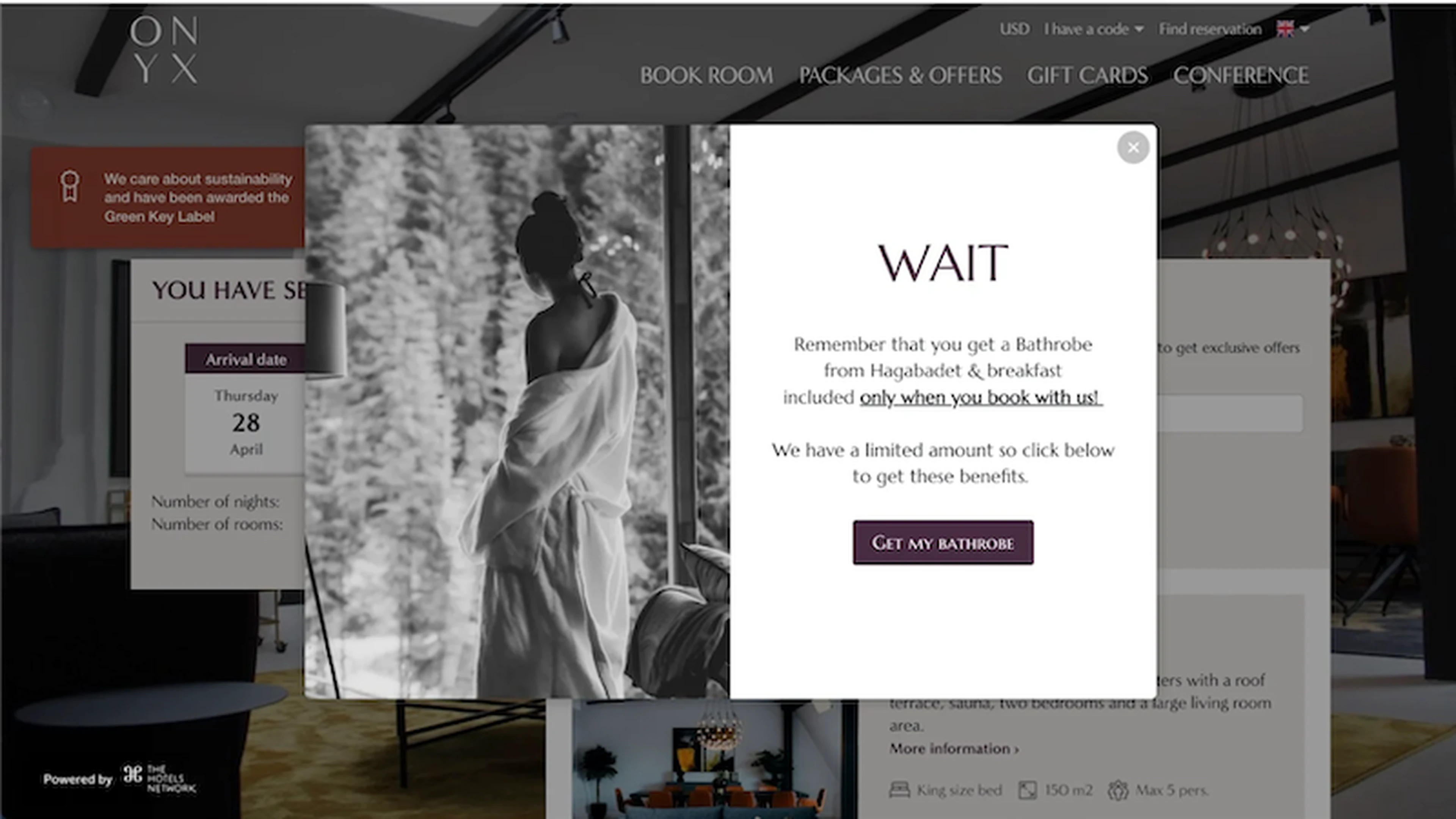
Harness the power of personalization features to truly engage your website visitors. Imagine a scenario where a user is browsing your booking engine, exploring dates, but then hesitates, about to abandon their cart.
Exit messages, within Lighthouse Direct, can detect this imminent departure and trigger a tailored message. This could be a reminder of exclusive direct booking perks, a personalized discount for their specific dates, or an offer for a value-added service.
This type of dynamic, personalized communication not only entices the booker to remain on your website and complete their reservation, but it also fosters a more intimate and engaging user experience that strengthens brand loyalty.
Strategy 5: Combat discrepancies with proactive price matching and comparison
When a potential guest is on your website, poised to book, and they've just discovered a lower rate elsewhere, that moment is critical. You need to act instantly to save the booking. This is where real-time price matching becomes a game-changer.
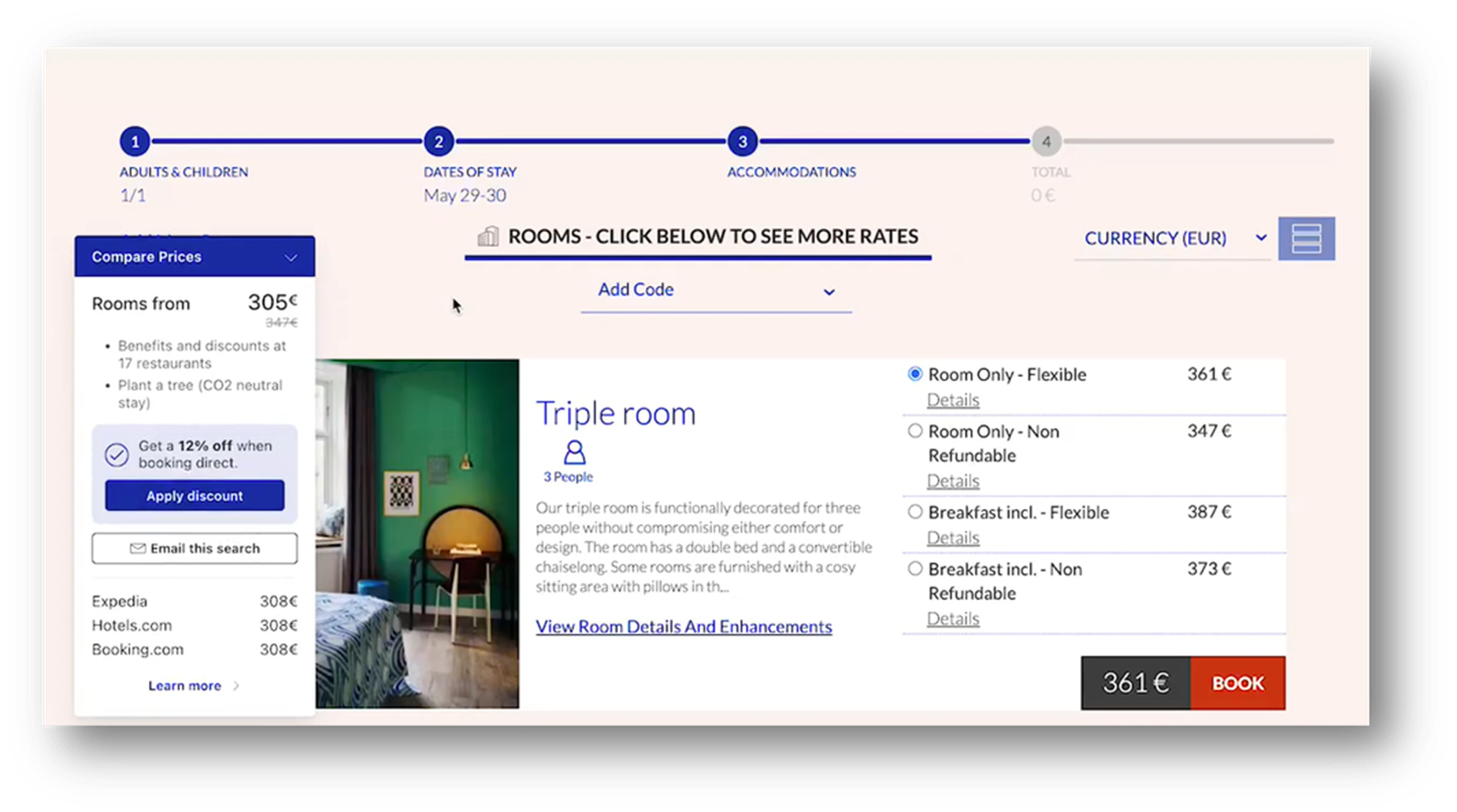
With Price Match, this can be done in real time to effectively combat any third-party rate tempting users away from your website
If your monitoring tools detect that a third-party is undercutting your rate, your website can automatically present the user with an offer to match that lower price. With a single click, the discount is applied directly within your booking engine, eliminating their reason to leave. This seamless experience not only secures the booking but also reinforces trust.
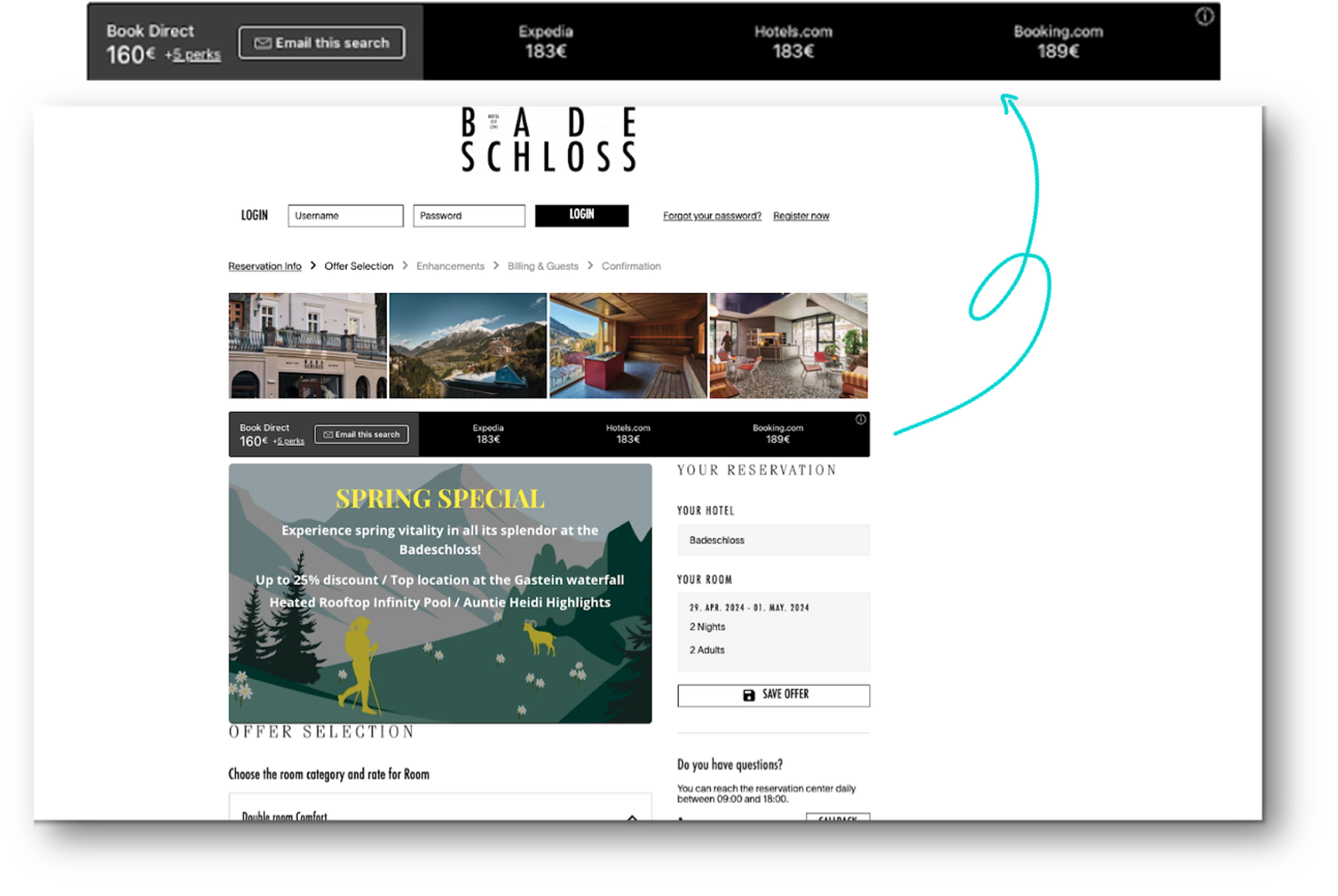
Equally important is Price Comparison. Even if OTAs aren't actively undercutting you, guests will still shop around. By integrating a price comparison widget directly on your website, you can proactively show visitors that your direct rate is the best available, alongside the rates of key OTAs.
This provides immediate reassurance, negates the need for them to stray to other sites to compare prices, and keeps them firmly within your direct booking funnel.
Strategy 6: Scrutinize your wholesaler and OTA relationships
One of the most complex and persistent sources of rate disparity often stems from the intricate and sometimes opaque web of relationships between hotels, wholesalers, and OTAs.
A prevalent issue is rate leakage, where wholesalers – who are typically provided with heavily discounted rates under the assumption they will sell them as part of B2B packages – end up reselling this inventory to non-contracted OTAs or other third parties who then aggressively undercut your direct rates.
This practice happens frequently, often without your direct knowledge or control. But there are ways to mitigate this challenge.
Conduct thorough due diligence
Before entering into any agreements, thoroughly vet potential wholesaler partners. Seek references, check industry reviews, and investigate their distribution history.
Set clear and strict contract terms
Your contracts with both OTAs and wholesalers must be explicit. Clearly define where and how your inventory can (and cannot) be sold. Include stringent rate parity clauses and specify the consequences for breaches. Consider implementing "BAR pricing and no allocation" to maintain operational control of the channel.
Work dynamically with wholesalers
Instead of offering static, discounted fixed rates, explore dynamic pricing models with your wholesalers. This reduces the incentive for them to undercut you by limiting the margin they can exploit. It also allows you to adjust wholesaler rates in line with your overall revenue management strategy, growing your Average Daily Rate (ADR) with them.
Monitor reselling practices
Use rate intelligence tools to actively track where your wholesale rates are appearing. If you find your inventory on unauthorized channels, approach the wholesaler directly, armed with your contractual terms and the evidence you've collected.
Strategy 7: Cultivate a book direct culture with loyalty and exclusive member rates
Every traveler loves to feel like they're getting the absolute best deal, coupled with a sense of exclusivity.
OTAs understand this, which is why programs like Booking.com Genius or Expedia VIP are so effective at building their own customer loyalty. You can, and absolutely should, replicate and surpass this feeling of exclusivity on your own direct channel.
Create your own compelling loyalty program or implement "members-only" rates that are exclusively available to guests who book directly through your website. This strategy achieves several critical objectives:
Guaranteed lowest rate promise: By offering an exclusive member rate, you can genuinely guarantee that the lowest possible price is always found on your site, without constantly battling third-party undercutting.
Enhanced value proposition: Couple these exclusive rates with the value-added perks mentioned earlier.
Direct relationship building: When guests join your loyalty program, you gain invaluable first-party data. This allows you to build a direct relationship, personalize future communications, and market to them without paying commissions.
Closed user groups: Consider closed user group rates, where special codes are distributed through specific, controlled channels (e.g., corporate partners, email subscribers). This offers a targeted way to provide exclusive discounts without publicly breaking parity.
The aim is to ensure that when a customer lands on your website, they instantly feel they are getting the best deal and the most comprehensive package, fostering a deeper connection with your brand.

Take action on rate disparity
Rate disparity is an undeniable, persistent challenge in the constantly shifting world of hotel distribution.
It's a game of whack-a-mole that demands continuous attention. However, by strategically implementing these seven winning strategies – blending cutting-edge technology with smart partnerships and proactive guest engagement – you can proactively combat these inconsistencies and truly strengthen your direct booking channel.
Reclaim control of your pricing, reinforce guest trust, and ensure your hotel's website remains the most compelling place to book with Lighthouse Direct. Your profits and your brand's reputation depend on it.
Frequently asked questions about rate disparity
Why is my hotel’s rate cheaper on OTAs than on my own website?
The most common reasons are OTA-only promotions set up in an extranet, currency conversion differences, wrong rate mapping from the reservation system, and wholesalers reselling contracted rates. Rate monitoring shows which channel is undercutting and when, so teams can trace the cause instead of guessing.
How much revenue do hotels lose to rate disparity?
Every booking that moves from a hotel’s website to an OTA carries a commission, often 15% to 30%. SHR analysis of 27 million cost-per-click impressions also found hotels pay 47% more per click when OTAs offer the cheapest rate.
How can hotels find out which wholesaler is leaking their rates?
Rate intelligence tools track where contracted wholesale rates appear and flag resale on unauthorized channels. With that evidence, a hotel can raise the breach with the wholesaler under its contract terms. Lighthouse Distribution helps trace the source of the leak.
What is a best rate guarantee?
A best rate guarantee is a promise that guests will not find a lower price for the same room and dates anywhere else. It builds trust and gives guests a reason to book direct, but only works if third-party promotions never undercut the direct rate.
How do price matching and price comparison work on a hotel website?
Lighthouse Direct can detect a lower third-party price and offer the guest a matching price in the booking engine in real time. A price comparison widget also shows the direct rate beside key OTAs. Both aim to stop guests leaving the website to compare.