What hotels need to know about revenue management automation
:format(webp))
Revenue management automation is becoming standard practice across the hotel industry, also for smaller independent properties.
Revenue management automation (RMA) is the use of software that applies custom rules and thresholds to routine pricing and inventory decisions, triggering rate changes and alerts automatically when market conditions shift, rather than requiring a person to catch and react to every change manually.
Many hoteliers are now implementing at least one form of automation or AI into their revenue management tech stack. For hotels without an automated system, this can lead to vulnerabilities, stronger competition and missed opportunities.
Take an example: Late on a Saturday night, a large music festival is announced for a future date on social media. No one is there to implement strategy changes and guard the hotel’s inventory. Eager guests are able to book single-night stays at affordable rates before prices can be raised and inventory restrictions are implemented.
By Monday, the hotel has sold most of its inventory far below market ADR. Meanwhile, their competitors still have plenty of rooms to sell, and have been able to capture much higher rates.
That blind spot cuts both ways. The same hypothetical hotel can just as easily leave rates too high after competitors quietly drop their prices, then wondering weeks later why occupancy is so low.
Hotels that successfully respond to every (seemingly) unpredictable market shift tend to have one thing in common: they utilize some form of Revenue Management Automation.
Key takeaways
Revenue management automation means letting data-driven software align room rates automatically with demand, instead of checking and updating them manually every time the market shifts.
Without pricing automation, hotels risk selling out at low rates during demand spikes and missing bookings because rates stay too high compared to what competitors are charging and what real-time demand actually supports.
When choosing a revenue management automation tool, verify what data sits behind its price recommendations and whether you can trust it to push updates to all channels to avoid extra manual work.
The best revenue management software offers customizable strategy settings, flexible automation, algorithm transparency and easy overrides when you have context the system is missing.
Independent hoteliers using the Lighthouse platform's Pricing Optimization see an average 21% increase in what each room earns (RevPAR).
What is revenue management automation?
Revenue management automation is the process of automating routine pricing and inventory tasks using a system that lets you define rules and thresholds. When specific market conditions are met, the system takes action (or flags it for review), rather than requiring a person to monitor the market constantly and react to every change manually.
Consider this: a revenue manager sets a custom rule in her automated RMS to push a $25 rate increase to both the CRS and PMS, but only when the hotel picks up more than 10 rooms over a 24-hour period for a specific day. She then copies this rule and applies it for all weekdays over the next 6 month period.
Although this is a simplified example, you can still imagine the time savings this creates for our fictional revenue manager.
Before implementing this automation, she would spend around 10 minutes every weekday morning exporting and then analyzing her on the books report looking for dates that had pickup exceeding 10 rooms. She would then highlight each date that met the criteria in a spreadsheet, and then manually type in the new rate change into her PMS, cross referencing her spreadsheet.
Apply this process every morning over the course of an entire working month, and suddenly this simple automated revenue management task now saves several hours monthly. Add to this the potential reduction in human errors that happen over the course of the month due to highly manual processes involving spreadsheets and disparate systems.
This example only scratches the surface of the potential time savings that a well-calibrated, automated revenue management system can unlock.
Hotels need to use automation strategically
While automation is sometimes touted to be a silver bullet that will solve all of your revenue management woes, there is still something important to remember: automation should always be used strategically.
Any rules, alerts or automations should be periodically audited to ensure that they are producing the desired results. After all, airline pilots still make adjustments to their autopilot system mid-flight, and can take back the controls in the event that something unexpected arises.
Hoteliers should think of revenue management automation in the same light. An automated revenue management system should always be monitored and recalibrated to make the most optimal decisions.
With this consideration out of the way, let’s talk about why automation can be such a game-changer for hoteliers.
The biggest time-eaters in revenue management
According to results from a recent Lighthouse survey, the two biggest data-related challenges for hoteliers were lack of time to analyze data and data silos, respectively. Other challenges that topped the list included: data overload, lack of effective tools, and lack of actionable data.
What’s interesting is that many of these challenges (data silos and lack of effective tools especially) are actually the cause of the biggest challenge (lack of time to analyze data).
Revenue managers need more time to think strategically, access their data and quickly extract the right insights for effective commercial decision-making. For RMs, the biggest time-eaters are: pulling reports from different sources, manually poring over those reports, and report bundling. These are tedious tasks that take away from the more meaningful data analysis they’d rather be doing.
For the General Managers or owner/operators of independent hotels, the biggest time-eaters include manually pricing individual dates, and juggling data from various inadequate tools, which keeps them from what they’d rather be doing: creating the best possible stay for their guests.
If any of these challenges sound familiar to you, it may be a sign that you could benefit from implementing an automated revenue management system. An automated revenue management system solves these challenges that both roles face by making data analysis more efficient and approachable.
How so? Automated Revenue Management systems can succinctly summarize overnight changes, alert users to exception dates, and clearly present the data and logic used in its automated decisions, which represents massive time savings.
Choose a tool with the capabilities you need
Before making a decision, it’s important to compare the various solutions for automated revenue on the market.
Each solution offers different core features at varying degrees of complexity and different price points, meaning that not every solution will be a one-size-fits-all for your hotel. As a hotelier, you know best what capabilities are most important for your unique situation.
Consider factors such as your existing tech stack (for instance, what is my property management system or channel manager? Are they compatible?). Even criteria like a user-friendly interface which might seem trivial at first, are important considering just how frequently the system will be used once you’ve committed to a solution. Other factors such as price, and whether or not you can trial the software up-front before purchase are also often top of mind.
Below, we list four solutions worth considering for independent hoteliers, along with a case for why each solution might be a good fit. It may even benefit you to jot down what you consider your top 3-5 criteria first, before reading up on each solution below, to see which has the most overlap with your list.
4 Top solutions for automating revenue management
#1 – Lighthouse - Pricing Optimization
Of all the solutions listed here, Lighthouse's Pricing Optimization stands out for its high-quality rate recommendations, customizable automation and algorithm transparency that makes it easy to accept or overrule updates. It's part of Lighthouse's AI-enhanced platform for independents, designed to automate and optimize independent hoteliers' pricing and distribution strategy. With rate adjustments based on internal performance metrics, competitor pricing and the best market intelligence data in the industry, it enables properties to increase revenue and reduce commission costs with minimal manual effort.
Key features include:
Automated, Transparent Rate Recommendations: Delivers 365 days of optimized rate suggestions and full reasoning behind them, updated up to three times a day, to ensure pricing aligns with current market conditions.
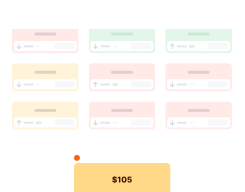
Proven Results: Independent hoteliers using Pricing Optimization see an average 21% increase in what each room earns (RevPAR) and automate 10 hours of revenue management daily.
Powered by Industry-leading Market Data with Forward-looking Demand: Monitors 1.8 billion hotel prices daily, offering the most comprehensive insights to help your property stay competitively positioned.
Customizable Autopilot Mode and Strategy Settings: You stay in control with flexible settings and fully disclosed rate calculations.
Live Competitor Rate Shopping: Clear overview of competitor prices for different room types and booking channels.
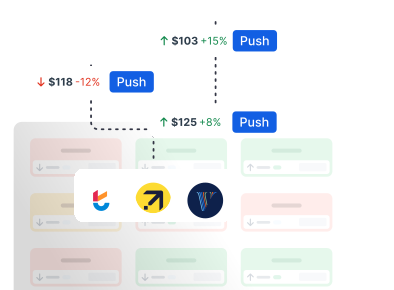
Straightforward Performance Insights: Management report with key metrics, Occupancy and Pick-up calendars, Rate Evolution and Pace dashboards versus your main competitors.
Top-rated Customer Support: Global customer support in 14 languages ensures peace of mind across all time zones.

#2 – Cloudbeds - Revenue Intelligence Software
Cloudbeds' Revenue Intelligence is an advanced revenue management solution designed to help lodging businesses optimize their pricing strategies. By automating rate adjustments based on real-time data and market trends, PIE enables properties to maximize revenue and maintain a competitive edge.
Key features include:
Demand Forecasting: Knowing demand 90 days out means you can price proactively instead of reacting to market shifts.
Proven Results: Users can achieve 18%
higher potential RevPAR and save 15+ hours weekly.
Competitor Rate Shopping: Monitor competitor rates in real-time to make informed pricing decisions and stay ahead of your compset.
Causal Pricing Engine: Every recommendation is tied to a predicted business outcome, so you can prioritize and act without second-guessing.
#3 – RoomPriceGenie - Real Time Pricing Optimization
RoomPriceGenie's real-time pricing optimization automatically adjusts hotel room rates in response to internal data (like PMS information) and external market conditions. This dynamic approach ensures that hotels consistently offer competitive prices, leading to increased revenue and improved occupancy rates. Compare RoomPriceGenie and Lighthouse features and pricing side by side.
Key features include:
Automated Price Adjustments: Updates room rates multiple times a day based on real-time and historical Airbnb as well as internal data, with exact frequency depending on your plan.
Competitor Rate Monitoring: Tracks pricing of up to 10 competitors plus Airbnb market data to keep your property competitively positioned.
Advanced Performance Monitoring: Multiple dashboards give detailed insight into your hotel's results: Revenue, Occupancy, Booking Pick-up, Forecasting and Budget.
#4 – Little Hotelier - Dynamic Revenue Plus
Dynamic Revenue Plus is Little Hotelier's dynamic pricing add-on (powered by SiteMinder), built for B&Bs, boutique hotels and other small independent properties that want pricing help without a steep learning curve. It layers on top of Little Hotelier's existing property management system, channel manager and booking engine, so pricing sits alongside the rest of your day-to-day operations. See our in-depth comparison of Little Hotelier and Lighthouse here.
Key features include:
Daily Pricing Recommendations: Data-driven rate suggestions updated daily, with the choice to automate them or apply changes manually.
Local Demand Visibility: Flags upcoming holidays and local events early, so you can adjust prices before demand actually picks up.
Competitor Benchmarking: Comparative reports show how your bookings, rates and availability stack up against nearby properties.
Mobile Alerts: Real-time pricing and competitor alerts delivered straight to the Little Hotelier app.
Improve pricing and optimize revenue management with a robust automation solution
Selecting the right automated revenue management tool for your hotel is no small undertaking, but when you have a better grasp of what you stand to gain by implementing an automated revenue management system, it should be apparent that the benefits far outweigh the costs.
Implementing an automated solution like Lighthouse’s platform with Pricing Optimization is one way for hoteliers to safely and effectively start incorporating automation and AI into their tech stacks without breaking the bank on expensive solutions with steep learning curves created only for large organizations.
To see an automated revenue management system in action and experience how it benefits your hotel, get started with a free trial now.
Frequently Asked Questions
Is revenue management automation only worth it for large hotels?
On the contrary, independent hotels and small groups are often where revenue management automation has the biggest relative impact, since owner-operators and small teams without revenue managers have the least spare time to manually monitor and adjust rates.
Do I need to be or have a revenue manager to use revenue management automation?
No, you do not need formal training or revenue management experience to use an automation tool. The Lighthouse platform's Pricing Optimization offers reliable automation that keeps you in control. It explains each suggested rate change in plain language, so you can understand what is driving it and adjust with confidence.
How much does hotel revenue management automation cost?
Costs vary widely by property size and feature set, from standalone tools to rate optimization capabilities bundled into a platform. Most reputable vendors, including the ones above, offer a free trial or demo we recommend using before committing.
What if a suggested rate looks wrong for my property?
With the right revenue management automation tool, you stay in control. Every rate Lighthouse suggests comes with the full calculation behind it, so you easily change it if you know something the system does not. You can also customize when to turn on Autopilot and when you want to review recommendations before pushing them to channels.
Can I use a revenue management automation tool if I run my property alone?
Yes, if you choose a solution like Lighthouse that is built specifically for independent hoteliers doing it all themselves. Once your strategy, desired thresholds and other settings are configured, Pricing Optimization can run in the background while you focus on guest service.