New hotel checklist: 12 essential steps before opening your property
:format(webp))
The practical checklist to make sure your hotel is priced, bookable and ready to sell from day one.
Opening your independent hotel is exciting. But before your first guest walks through the door, there is one big question:
Are you commercially ready?
Many independent hoteliers start with spreadsheets, manual price checks and guesswork. In the first few months, they spend hours comparing rates on Booking.com, adjusting prices in Excel and reacting too slowly to demand changes. At the same time, confusing rate plans are deterring guests.
But that’s not all. OTA listings start to take off, with commissions eating into margins, while your own website lags behind.
Before you go live, you need clarity on:
Who you are positioning your hotel for
How you structure your rooms and rate plans
How you price confidently
Where and how you distribute inventory
How you limit OTA commission costs
This practical checklist walks you through the essentials that directly impact your revenue and your time. If you can confidently tick off every section below, you’re ready for the big opening day with a solid strategy in place.
1. Define your hotel’s identity, positioning and value proposition
For an independent hotel, your own identity is a key asset to distinguish yourself from competitors. If you try to attract everyone, you’ll simply blend in – and that’s the last thing you want when opening a hotel.
For people to see your value, everything you show online needs to be aligned with your identity: : your property, ideal guest, website, social media…
So, before you think about pricing or channels, you should get clear on who you are and who you serve.
Define your target guest clearly
Everything starts with a deep understanding of your target audience.
Ask yourself:
Are you kid-friendly and pet-friendly?
What price category are you in?
Which types of tourists visit your area?
Do you cater to city-trippers, digital nomads, couples, families…?
Next, list all key characteristics of your target guest(s):
Typical length of stay
Booking window (last-minute or >3 months ahead)
Price sensitivity
Key expectations (location, atmosphere, service, amenities)
Clarity here makes every other decision easier.
Decide your market positioning
Are there any hotels in your market you aspire to be compared to?
Keep this in mind when deciding your market position:
Price level
Accommodation type
Traveler type
Tone of voice
Rate plan structure
Determine what you’re competing on, for example:
Price?
Design and experience?
Location and convenience?
Be realistic. If you price like a boutique hotel, the entire experience must justify it. Any discrepancy between your positioning and reality damages your reputation and performance.
Write and test your value proposition
Your value proposition ties your guest profile and your positioning together in one clear message.
In one or two sentences, define:
Who your hotel is for
What makes it different
When someone lands on your website, they should understand within a couple of seconds why they should book you instead of a competitor.
What you’ve decided in this first step will shape your website, OTAs, ads and pricing structure. When you know exactly who you attract and what you offer, you avoid competing purely on price and protect your margins from day one.
:format(webp))
2. Set up your room types
Overcomplicating your room categories confuse guests and hurt conversion.
Create a clear hierarchy, structuring your rooms from your entry-level room to your top category. Each level up should add something tangible that guests value.
These are the most common distinctions:
More space
Larger bed
Better view
Balcony or terrace
Additional amenities
Avoid overlapping categories that make guests hesitate. If the difference between “Superior” and “Deluxe” is unclear, rethink the structure. Use descriptive names based on size, layout, view or other features.
It’s crucial to keep your room names and descriptions identical across:
Your website and booking engine
PMS
Guest emails
Otherwise, potential guests may question whether prices and amenities are correct. When guests immediately understand what they’re booking, they decide faster and are less likely to leave your website to compare options elsewhere.
3. Build a logical rate plan structure
For travelers booking accommodation, easy comparison is key. Just like your room types, your rate plan structure should be as simple as possible, with clear differences between rates.
Too many options, small price differences and complicated wording all lead to decision fatigue.
Start with a clean foundation:
Flexible rate
Non-refundable rate
Breakfast included (if applicable)
Clarity beats complexity. Simple rate plans are easier to explain, easier to manage and easier to sell.
Make differences obvious, so guests instantly see why one rate is cheaper than another. If the price gap between flexible and non-refundable is almost negligible, most guests will pick flexible. Make the difference meaningful in order to secure more committed bookings when demand is strong.
Clearly communicate:
Cancellation policy
Payment timing
Included services
Consistency is important here too, so double-check descriptions of policies and restrictions on OTAs and your own website.
4. Establish your price point and strategy
Your price is the first thing potential guests see and it immediately signals where you sit in the market. Too low, and you risk looking low-value. Too high, and you set expectations that might be impossible to meet.
Set one flexible base rate per room type
Start by defining a clear base rate for every room category. This will be the foundation of your entire revenue structure.
It should be:
Refundable
Your main public rate
The anchor for all other rate plans
From this base rate, you can build:
A slightly lower non-refundable rate
Breakfast-included options
Package rates with added value and services
Align with your competitive set
Do not copy competitor prices blindly, but compare strategically.
A hotel with stronger reviews and better amenities can justify higher pricing. A new property often needs slightly more competitive positioning in the beginning, but not at the expense of perceived value.
Not sure who your true competitors are? Learn all about building your competitive set (compset) in this blog.
Define your boundaries
Before opening, set your limits:
A minimum rate you will not go below
A maximum rate you feel confident charging during peak demand
Minimum boundaries prevent panic discounting during slow periods. Consistently dropping your rates can condition the market to wait for these discounts. Maximum boundaries prevent overpricing during events, holidays and peak seasons.
Finetune your pricing strategy and prepare to scale
Many independent hoteliers spend between two and ten hours per week checking competitor prices and adjusting rates manually. That might work at first, but once bookings pick up, it quickly becomes unsustainable.
In the first three months:
Monitor occupancy weekly
Track booking pace and pick-up
Observe how far in advance guests are booking
This is how you learn your booking curve and demand patterns to finetune your pricing strategy.
Already start looking into hotel pricing software now, before things get too overwhelming, so you’re ready to scale.
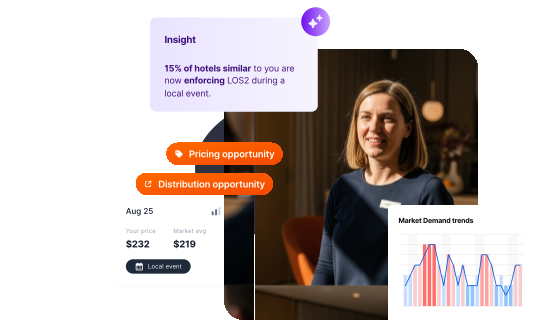
An AI-powered solution like Lighthouse can automatically analyze competitor rates, market demand and local events and update your prices in real time. That way, you don’t fall behind on bookings and revenue by reacting too late. You stay ahead and optimize your online presence, while still adhering to your price limits and other rules you set.
Automation does not take away control, but empowers you to execute your strategy consistently while giving back time to focus on other tasks.
:format(webp))
5. Choose the right booking channels
More visibility sounds good, but the goal is not to be everywhere. It’s to:
Be present where your guests actually search
Generate bookings that support your bottom line
Keep an overview and stay in control
Select channels that match your guest
Before signing up to any OTA, revisit your target audience. A business-oriented city hotel and a countryside retreat don’t need the same distribution mix. Choosing channels strategically keeps your setup manageable, focused and effective.
Not all channels serve the same purpose. Some platforms bring reach and visibility, others drive booking volume and some allow for better margins. A healthy balance is key. Read more about choosing the right booking channels here.
Understanding your commission math
A $150 room sold through an OTA with a 15% commission costs you $22.50. At 100 bookings per month, that’s $2,250 in commission.
That doesn’t mean OTAs are bad. They bring visibility and demand. But understanding the math helps you balance exposure and profitability.
A strong direct booking module on your website, combined with a smart pricing strategy, can significantly reduce commission costs.
Automate synchronization and double-check settings
When you don’t have a distribution team, every extra channel adds complexity, work and risk of errors. On the other hand, sticking to one high-commission OTA hurts your profitability. That’s why you need a channel management tool to keep your distribution channels in sync.
Before going live, carefully review your availability, pricing, restrictions and room mapping across all platforms. Even a small configuration error can cost you revenue or lead to overbookings early on.
Check:
Room-to-rate mapping
Minimum stay rules
Closed dates
Price consistency
A clean distribution setup protects your launch and reduces unnecessary stress in your first weeks of operation.
6. Make your hotel easy to book
If your booking process feels confusing or slow, guests simply close the tab. Booking should feel straightforward, smooth and reassuring, even on mobile devices, where most leisure bookings now happen.
Align your pricing and policies everywhere
Guests often compare your website and (multiple) OTAs side by side or on metasearch platforms like Google Hotels. Any discrepancies can raise doubt.
Make sure:
Room names and amenities match exactly
Pricing is consistent
Cancellation policies are aligned
Make key information visible
Guests want clear information without digging through paragraphs of text.
To avoid hesitation and complaints, clearly display:
Cancellation deadlines
Payment timing
What’s included in each rate
Test the full booking journey
It’s crucial for your booking experience to be as smooth as possible for guests. Any friction in booking, payment or confirmation fuels uncertainty and distrust.
See if your hotel website meets all criteria with this practical website checklist.
:format(webp))
7. Upload professional photos that sell rooms
Photos shape expectations instantly. Before guests read your description, they’ve already formed an impression based on your images. Strong visuals support your pricing. Weak or misleading visuals undermine it.
Use high-quality photos for every room type
Each room category deserves its own clear visual representation. One generic image for multiple categories creates confusion.
Include:
A full-room overview
Bathroom photos
Key distinguishing features or amenities
Environment of your property
Clear visuals justify price differences and reduce uncertainty. Guests should immediately understand what they’re paying for.
Convey the full experience
Guests are booking more than a bed. They’re booking an experience.
Include:
Lobby or reception
Breakfast area
Exterior and surroundings
Context helps guests picture their stay from arrival to departure. The easier they can imagine it, the easier they can commit.
Have you already written out a full marketing plan for your hotel? From website and SEO to email marketing, you can find the full breakdown in our marketing guide to make sure you haven’t missed anything.
8. Ensure your tech setup is seamless
Every accommodation needs technology to some degree, but using disconnected tools can slow you down instead of improving efficiency. It creates manual work, duplicate data entry and room for error. Your systems must work together seamlessly from day one.
Ideally, your initial setup could include:
Automated pricing recommendations
Channel synchronization to avoid overbookings
A direct booking module on your website
Secure online payments
Reservation management for check-ins and guest communication
Integrations with your accounting or POS system
The simpler and more connected your systems are, the more time you save.
Configure your PMS correctly
Your property management system or reservation software is the backbone of your operations.
To prevent chaos, double-check:
Room type setup
Rate structures
Restrictions
Availability settings
Integration and mapping with other systems
Confirm syncing across all channels
Your channel and pricing management tools must synchronize automatically in real time. If not, overbookings or incorrect prices can appear fast and damage trust.
Test:
Pricing, restrictions and availability changes
Syncing between booking channels
Minimum-stay rules
Test booking and payment scenarios
Run real test bookings under different conditions to ensure everything works properly.
Simulate:
Flexible bookings
Non-refundable bookings
Mobile reservations
Different card types
If something requires manual intervention immediately, it needs fixing before opening. Smooth systems create a calm launch.
:format(webp))
9. Prepare your guest communication flow
Since most misunderstandings are caused by misaligned expectations before arrival, proactive guest communication is key. It prevents repetitive questions, confusion and complaints.
Finetune confirmation and pre-arrival emails
Your confirmation email should answer the questions guests typically ask later.
Include clear details about:
Check-in times
Parking
Breakfast
Cancellation rules
But don’t forget that guest communication doesn’t stop after check-in. There are many ways to engage guests, upsell during their stay or even entice them to book again. Read all about email marketing in our blog.
Reinforce key policies
Guests may not remember the exact rate they selected. Repeating important details avoids confusion.
Clearly restate:
Cancellation deadlines
Payment terms
Inclusions
Repetition reduces friction. Clear expectations protect early reviews.
Align tone with your positioning
Your tone should reflect your personality and positioning. A boutique property should sound warm and personal. A business hotel should sound efficient and direct.
Consistency across your website, emails and front desk communication strengthens your brand. A unified voice builds familiarity and trust.
Wondering how you can automate different parts of the guest journey? Read all about it in this blog on guest journey automation.
10. Get ready for guest reviews
Plan your review strategy
Your first reviews carry extra weight and can accelerate your growth when managed well. They influence how future guests perceive your value and quality.
Make a clear plan to manage reviews, so you don’t miss early momentum:
Which platforms will you prioritize?
How and when will you request reviews?
How will you phrase requests to encourage reviews?
How will you respond to reviews consistently?
How will you use feedback to refine guest experiences?
Respond thoughtfully and swiftly
Every review deserves your attention. You don’t have to respond to every single one, but prioritize negative ones and show that you take the feedback to heart. Always reply promptly, professionally and authentically. Calm, constructive replies strengthen trust with future guests.
If you have very limited time, or many rooms and channels to manage with a small team, adopting an affordable tool to speed up replies is really worth it.
Want to streamline your hotel operations and save time every day?
Download the free handbook for independent hoteliers in your language – complete with checklists, workflows and practical tips.
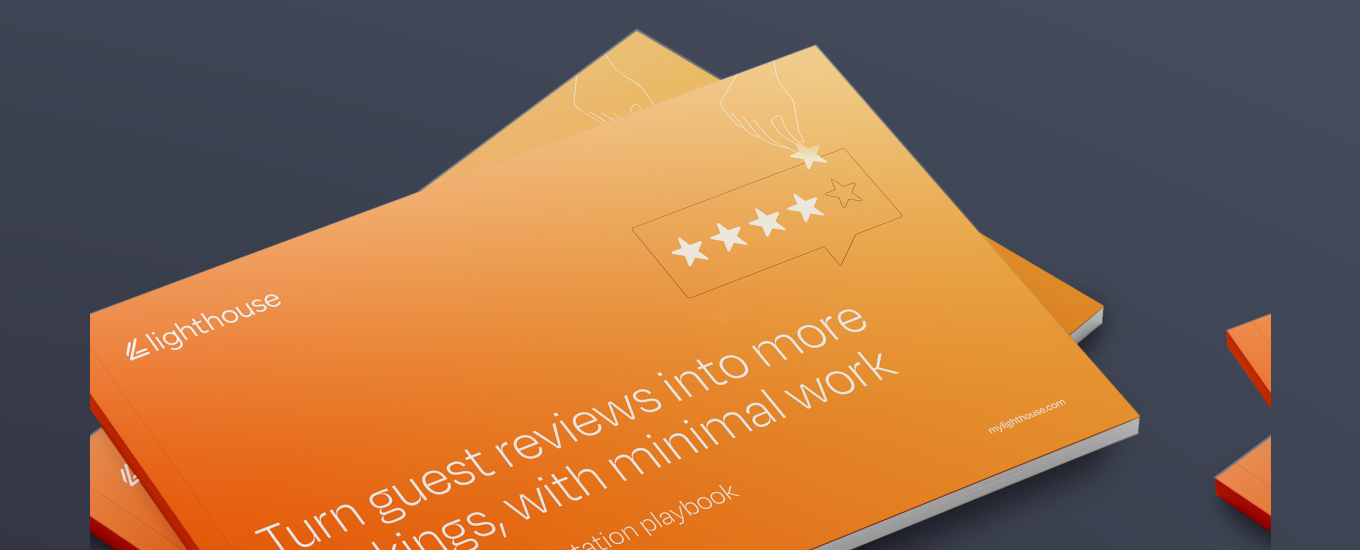 This is where Lighthouse supports independent hoteliers as well. With the Review Agent feature you can bring your Booking.com and Expedia reviews into a single dashboard, where you can read, reply and automate responses without switching between platforms. AI-generated replies go out in one click – personalized and translated – or Autopilot handles everything based on score thresholds, flagging lower scores for your attention.
:format(webp))
11. Make sure you tell the same story everywhere
Guests compare your pricing, photos and messaging in seconds. If they don’t align, trust erodes. Consistency across all touchpoints creates credibility.
Align promise and reality
If you describe your property as luxury, your rooms, pricing and service must support that claim. If you position yourself as budget-friendly, own it confidently.
Mixed signals create doubt. Clear alignment builds confidence.
Align visuals, descriptions and rates
Double-check that:
Room descriptions match reality
Photos reflect current setup
Pricing matches positioning
Expectation gaps are one of the biggest causes of negative reviews. Consistency protects your reputation.
Highlight relevant local context
Help guests understand why staying with you makes sense.
Mention:
Nearby attractions
Events
Nature
Business hubs
Context makes your hotel feel purposeful, not generic.
Did you know you can even partner up with other businesses to stand out from the competition? Read all about strategic partnerships in our blog.
12. Run a final launch check
After you’ve worked through every area in detail, it’s important to take one last step back before you officially open the doors. A structured final review helps you discover small issues you may have overlooked.
Evaluate your hotel as a guest
Look at your website and booking flow objectively.
Ask yourself:
Would I confidently book this hotel right now?
Is pricing clear without explanation?
Are room differences obvious?
Does the booking journey feel effortless?
If the answer is yes, you are not just ready to open – you are ready to succeed!
Lighthouse can help you launch your new hotel or B&B with confidence by making sure all essential tech is in place. Our complete platform helps independents thrive from the start while saving valuable time. Cost-effective and easy to use, even without experience.
Frequently Asked Questions
How many OTAs should a small hotel use?
Focus on the platforms your target guest actually uses. Start with one or two major channels and expand strategically. More channels only make sense if you can manage them properly.
Should I offer non-refundable rates when opening?
Yes. A clear non-refundable option helps secure committed bookings and improves cash flow, especially during high-demand periods.
How do I know if my price is too low?
If your rooms consistently sell out too early, you may be underpricing. Monitoring booking pace and competitor positioning helps you identify missed revenue opportunities.
How can I reduce OTA commission?
Strengthen your direct booking strategy through a clear website offer, better rate parity management and channel-specific availability logic.
Do I need pricing software if I only have 10 rooms?
Even small properties benefit from structured pricing. The fewer rooms you have, the more every booking matters. Consistent, data-driven pricing protects your revenue.
Non perdere mai un cambiamento di mercato
Ottieni gratuitamente la tua Dashboard degli Avvisi di Mercato, con i prezzi dei competitor, la domanda di mercato e gli eventi su misura per il tuo hotel
Loading author...