Hotel Rate Shoppers: What They Are and How to Choose
:format(webp))
Every pricing decision your hotel makes depends on knowing what the market is doing right now. That's the job of a rate shopper.
What is a hotel rate shopper?
A hotel rate shopper is a software tool that automatically collects, compares and monitors competitor room pricing across online travel agencies (OTAs), metasearch engines, brand.com sites and global distribution system (GDS) channels.
Revenue managers and hoteliers use rate shoppers to benchmark their property against the competition, spot pricing opportunities, maintain rate parity and make faster pricing decisions without manually checking dozens of booking sites every day.
"It took us days to collect competitor rates," says Tse Lin Kuo, Business Division Manager at Kindness Hotel. "Now, in 20 to 30 minutes, we have a full market view and can immediately adjust strategy."
By monitoring both your rates and your competitors' rates consistently, you start to see market trends emerge: how your market responds to events, where demand is shifting and which pricing strategies are working across your compset.
During a major conference or citywide event, for example, that same data lets you track market conditions in real time and adjust rates upward in step with demand rather than reacting after competitors have already moved.
That visibility is the foundation of a revenue management strategy that keeps your hotel competitive year-round.
Key Takeaways
A rate shopper automates competitor price collection and benchmarking across OTAs, brand.com, GDS and short-term rentals
Real-time or near real-time data refresh and broad channel coverage matter more than daily snapshots
Accurate room mapping, length of stay (LOS) comparisons, parity alerts and PMS/RMS integrations make pricing decisions faster and safer
Track time saved, parity issues resolved and ADR/RevPAR vs forecast after adoption to measure ROI and overall profitability
:format(webp))
How a rate shopper helps hotels drive revenue
Rate shoppers are the competitive intelligence layer underneath every pricing decision your hotel makes.
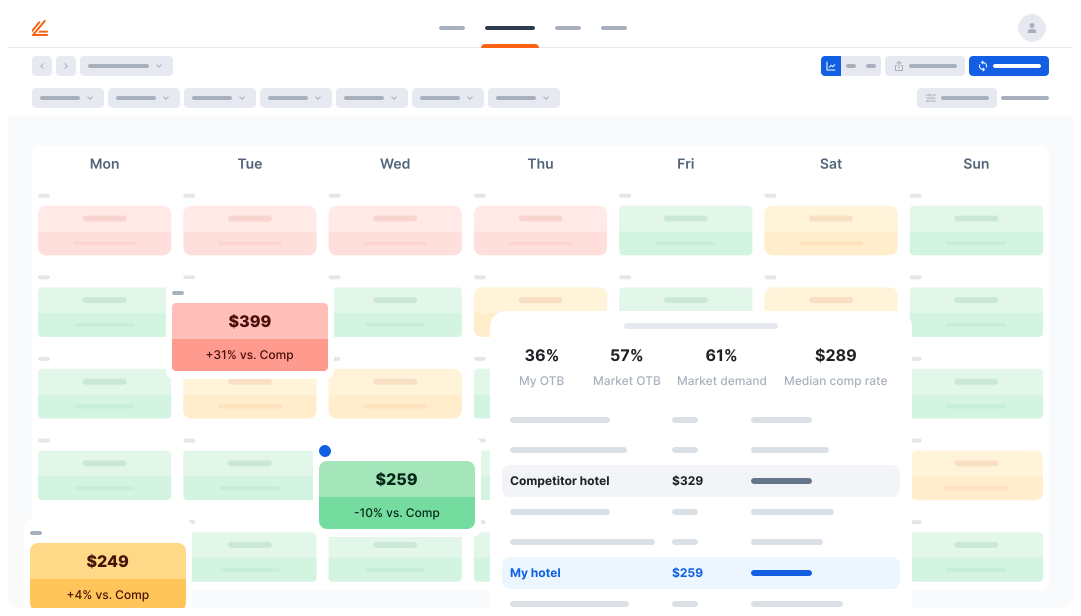
Price with confidence across your compset
Knowing how your hotel fits into its market means you can set rates that reflect current demand rather than guessing based on outdated assumptions. A rate shopper gives you the data to time adjustments to market demand, whether that's a demand spike from a citywide event or a compset-wide rate drop during a soft shoulder period.
"I can look at one line and see all of my competitors," explains Tanya Mare, Group Revenue Manager at The Capital Hotels. "I can see at a glance exactly where we're going wrong in terms of pricing."
Tip: Use event calendars and booking-window trends to time price changes instead of blanket increases.
Protect rate parity across every channel
Rate disparity across OTAs, metasearch and brand.com erodes both revenue and guest trust. Rate shoppers monitor all channels simultaneously, flagging discrepancies so your team can resolve them before they become a pattern. For hotel groups managing dozens or hundreds of properties, parity monitoring at scale is impossible without automation.
Tip: Confirm inclusions and policies before matching a competitor's headline rate. A lower published number sometimes includes fewer amenities.
React faster than your competition
The gap between identifying a market shift and acting on it determines whether you capture the revenue opportunity or your competitors do. Rate shoppers eliminate the manual data collection bottleneck so your team can spend its time on strategy rather than spreadsheets.
"If I hear about an important event, I log it in the system," says Pavel Jindra, GM at AC Hotel Bratislava. "That way, when demand picks up, I can immediately connect the dots and adjust rates."
Tip: Set alerts by threshold (for example, when a compset rate undercuts yours by more than €10) so your team focuses on action rather than monitoring.
Reclaim hours for higher-value work
Automating rate collection frees up significant time each week. For hotel groups, this compounds across properties. A cluster revenue manager overseeing eight hotels who saves 30 minutes per property per day gains back 20 hours a week for forecast reviews, parity remediation and competitive analysis.
"We save a couple of hours every single day," says Paola Cinquegrani, Director of Revenue at iH Hotels. "That's huge for a small team managing many properties."
How rate shopping fits into your pricing workflow
A rate shopper doesn't work in isolation. It's the data foundation that feeds your entire pricing chain:
Rate shopper → demand intelligence → pricing recommendation → distribution
Your rate shopper collects competitive pricing data across your compset, helping you understand the relationship between price and occupancy. That data flows into your revenue management system (RMS), which combines it with on-the-books data, historical performance and demand signals to generate pricing recommendations. Those recommendations get pushed through your channel manager to every distribution channel simultaneously.
Each link depends on the one before it. If your market data is stale or incomplete, every pricing decision downstream inherits that error. For hotel groups running centralized revenue management, a single data quality issue in the rate shopping layer can ripple across dozens of properties before anyone catches it.
:format(webp))
What to look for in a hotel rate shopper
The tool you choose determines the quality of every pricing decision your team makes. Five capabilities separate professional-grade rate intelligence from tools that create more work than they save.
Complete market visibility across every channel
Your rate shopper needs to cover every channel where your rooms are sold and every channel where travelers compare your rates: OTAs (global and regional), GDS, metasearch, brand.com and short-term rental platforms.
Short-term rental coverage is increasingly important. If your rate shopper is blind to Airbnb and Vrbo pricing in your market, you're missing a significant piece of the competitive picture. Look for tools that integrate all sources into a single view.
What matters most: Real-time or near-real-time data refresh, coverage of both global and regional OTAs and short-term rental monitoring where relevant to your market.
Data you can trust without second-guessing
Some rate shopping tools rely on cached or scraped data that can show significant variance from the rates travelers actually see. The best rate shoppers ingest data directly from source channels and apply automated anomaly detection across large data sets to flag outliers before they reach your dashboard. Ask providers about their data validation processes, completion rates and how they handle stale data points.
What matters most: Source-level data ingestion (not cached), automated anomaly detection and transparency about how rates are sourced.
Rate parity monitoring that protects your revenue
A good rate shopper monitors parity across all channels continuously and alerts your team the moment a discrepancy appears. For hotel groups, this needs to work at portfolio scale: parity status across all properties in a single view, with the ability to drill down to specific channels and dates.
Beyond detection, look for tools that show you the evidence behind each parity alert so you can identify which distribution partners are causing the issue.
What matters most: Automated parity alerts, portfolio-level dashboards and evidence trails for each violation.
Precise rate comparison that accounts for what matters
A headline rate number is meaningless without context. Your rate shopper should map comparable room types accurately across competitors, account for length of stay (LOS) differences and let you track how competitor rates evolve across the booking window.
Flexible competitive sets matter too. Your compset may shift by season, by event or by source market. The best tools let you maintain multiple compsets and switch between them without rebuilding from scratch.
"Using Lighthouse Pricing, we have a very good understanding of where we sit within the compsets," says Natalie Moore, Revenue Manager at Sun International. "It becomes really helpful for us to make those comparisons correctly and accurately, then activate any changes quickly."
What matters most: Accurate room-type mapping, LOS analysis, rate evolution tracking and flexible compsets you can update as market conditions change.
Integrations that connect to your existing tech stack
The data your rate shopper collects needs to flow into the systems where your team makes decisions: your RMS for pricing recommendations, your PMS for booking context and your channel manager for rate distribution.
Look for pre-built integrations across major platforms. Shared access matters too. When sales and marketing can see the same market intelligence as the revenue team, commercial strategy stays aligned.
"If I'm busy, a colleague can make the same decision I would," says Gianluca Guarino, Revenue Manager at CampusX. "They're looking at exactly the same data. It keeps us fast and aligned."
What matters most: PMS, RMS and channel manager integrations, shared team access and a clean interface that non-revenue users can navigate.
:format(webp))
How to evaluate and compare rate shopping tools
Choosing the right tool comes down to a structured evaluation against the criteria that matter most for your portfolio. A cluster revenue manager overseeing multiple properties will weight portfolio-level dashboards and multi-property parity monitoring differently than a single-property RM focused on compset flexibility and RMS integration. Define your priorities before you demo.
When comparing options, pay attention to these differentiators:
Data freshness.
Some tools update once or twice per day. Others provide continuous or on-demand refresh. In fast-moving markets, the difference between real-time data and a morning snapshot can mean missing a midday rate shift.
Data sourcing method.
Tools that ingest rates directly from source channels deliver more accurate data than those relying on cached or scraped results. Providers that show significant variance from actual market rates create more work for revenue managers who need to manually verify what they're seeing.
Demand intelligence.
Traditional rate shoppers show what competitors charge. The next generation combines competitive data with demand indicators like flight and hotel search volume, booking pace and event data, shifting your team from reactive to proactive.
AI and automation.
Some tools now include AI-powered dynamic pricing recommendations and proactive alerting that surfaces high-priority opportunities and risks automatically.
For head-to-head vendor comparisons and verified customer reviews, Hotel Tech Report publishes annual rankings of rate shopping and market intelligence solutions. When reading reviews, focus on feedback from hotels similar to yours in size, market and operational complexity.
Why Lighthouse Pricing goes beyond traditional rate shopping
Rate shopping alone isn't enough. The category is converging with demand intelligence and automated pricing into a single workflow, and the tools that win are the ones already built for that shift. Lighthouse Pricing is one of them.
Forward-looking demand intelligence. Most rate shoppers tell you what competitors charge today. Lighthouse shows you where demand is heading up to 365 days out by analyzing billions of pre-booking signals, so your team can spot compression dates and demand spikes before they appear in OTB reports. That's the difference between adjusting rates after a competitor moves and seeing the shift that caused it days earlier.
Revenue Agent: your daily market scan, handled. Revenue Agent's Smart Insights skill analyzes your market automatically and surfaces the highest-priority pricing opportunities and risks over the next 90 days, suppressing the noise that doesn't warrant your attention. Each insight links directly to the underlying data so you can validate and act in seconds rather than cross-referencing multiple tools.
Short-term rental visibility built in. 45% of travelers compare hotels and short-term rentals before booking. If your rate shopper is blind to that side of the market, your competitive picture has a gap you may not realize is there. Lighthouse monitors both in a single view.
Lighthouse serves over 70,000 hotels in 185 countries and has been ranked the number one rate shopping and market intelligence solution by Hotel Tech Report for six consecutive years.
"Revenue work depends on data. The value of Lighthouse Pricing is clear. It gives us the information we need to decide with confidence," says Jimmy Tang, Revenue Manager at Sotetsu Grand Fresa Taipei Ximen. “Since using Lighthouse, our RevPAR has increased 10% every month, and our year-over-year growth reached 20–30%. I now base all pricing on real demand.”
:format(webp))
Frequently asked questions
What is the difference between a rate shopper and an RMS?
A rate shopper gathers competitive room rates and hotel pricing data from OTAs, GDS and direct booking channels. A revenue management system (RMS) takes that data, along with your property's booking pace, historical performance and demand signals, and recommends or automates pricing decisions. The rate shopper feeds the RMS with the market intelligence it needs to set accurate rates.
What is the difference between a rate shopper and a channel manager?
A rate shopper pulls pricing data from distribution channels to show you where your hotel stands in the market. A channel manager pushes your rates, availability and restrictions out to those same channels. They serve opposite directions of the same data flow: one informs your strategy, the other executes it.
How often should a rate shopper update its data?
The best rate shoppers update pricing data in real time or near real time. Frequent refreshes matter most during events and sudden market shifts, moments when competitor rates can change multiple times per day. Tools that refresh only once daily risk showing stale data that leads to missed revenue opportunities.
How accurate is Lighthouse Pricing's data and room mapping?
Lighthouse Pricing uses automated data validation and anomaly detection to verify billions of rate points in real time. Its customizable room-type mapping aligns equivalent rooms and rate conditions across competitors, so every comparison is fair and accurate. You can view parity evidence directly in the dashboard.
What integrations does a rate shopper need to work effectively?
An effective rate shopper integrates with three core systems. Your PMS provides live booking and segmentation data. Your RMS receives market insights to power pricing recommendations. Your channel manager keeps rates aligned across OTAs and brand.com. Together, these integrations eliminate manual updates and reduce pricing errors.
Are there free hotel rate shopping tools?
Some providers offer limited free trials or freemium tiers with restricted data. Professional-grade rate shopping with real-time updates and accurate room mapping typically requires a paid subscription. Free tools rarely cover enough channels or update frequently enough to support reliable pricing decisions at scale.
How can I show ROI from a rate shopper to my GM or owners?
Start with three metrics: weekly hours saved on manual rate checks.
Also track parity issues identified and resolved per week and ADR/RevPAR performance vs your forecast for 30 to 60 days before and after adoption.
Report these monthly.
How much does a hotel rate shopper cost?
Pricing varies by provider, portfolio size and feature tier. For chains and groups, most rate shopping solutions scale with the number of properties, data sources monitored and integration depth. Most providers offer free trials; use the trial period to assess data quality, integration fit and workflow impact before committing.
What is rate parity and how do rate shoppers help?
Rate parity means maintaining consistent pricing for the same room type across all distribution channels: OTAs, metasearch, GDS and your direct website. When parity breaks, you risk losing direct bookings to channels offering lower rates, often at higher commission cost. Rate shoppers monitor all channels simultaneously and alert you to discrepancies before they erode revenue.
How is AI changing hotel rate shopping in 2026?
AI is shifting rate shopping from descriptive to predictive. Traditional rate shoppers show what competitors charge right now. The next generation combines that competitive data with pre-booking signals like flight and hotel search volume to show where demand is building before it hits the books. Lighthouse Pricing takes this further with Revenue Agent, which automatically scans your market and flags the rate moves worth acting on over the next 90 days so your team spends less time monitoring and more time on strategy.
What is a compset and how do I build one?
A compset (competitive set) is the group of hotels you benchmark your rates against. A strong compset typically includes five to ten properties that share your market, star rating, room count and guest profile. Build your core compset around your closest direct competitors, then create a secondary event-specific set for high-demand periods. Review and update both sets at least quarterly.
:format(webp))
:format(webp))