How does AI room pricing work for small hotels? A guide to stop guessing your room rates
:format(webp))
Italian version
:format(webp))
What is Pricing Optimization actually doing?
At its core, Pricing Optimization monitors a set of signals that affect what your rooms should cost and updates your rates to reflect them, continuously.
Here's what it's looking at:
Your own booking pace: how fast your rooms are filling for each upcoming date, compared to what's expected
Competitor rates: what properties in your area are charging right now, updated hourly
Local events and demand drivers: concerts, festivals, conferences, public holidays and anything else that affects how many people are looking for a room in your area
Historical booking patterns: what happened at your property on similar dates in previous years
Occupancy trend: how many rooms you've already sold for upcoming dates, and how many are still available to fill
The system weighs all of these together and produces a rate recommendation for each room type and each date on your calendar.
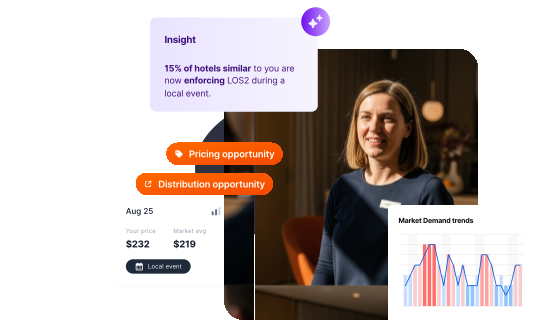
On the Lighthouse platform, those recommendations come with the reasoning behind them, so you can see exactly why a higher rate is being suggested for a specific Saturday, or why the platform is recommending you hold rates steady for a midweek in February.
What it isn't doing is guessing. Every recommendation is based on real-time, live data. And critically, nothing gets pushed to your channels without your approval – unless you specifically choose to switch on autopilot, which we'll come to later in this article.
You always stay in control of your hotel’s room rates with Pricing Optimization
This is the part that matters most to most independent hoteliers, and rightly so. You know your property, your guests and your local market in ways no system can fully replicate. Pricing Optimization is designed to support your knowledge, not override it.
Before the platform starts making recommendations, you set your guardrails:
A minimum rate below which your rooms will never be sold
A maximum rate above which prices won't go, even at peak demand
At least five competitors that reflect your real market, so the platform is benchmarking against the right hotels
Your base rate plan and room structure. This is the foundation the platform builds on, so recommendations reflect how your property is actually set up and sold
In general, Pricing Optimization shows you what it thinks you should charge and why. You review it, adjust it if you disagree and push it live when you're ready. Over time, as you build confidence in the logic, most hoteliers move toward higher levels of automation but that's entirely your call.
What hotel Pricing Optimization looks like in practice
Say you run a 20-room boutique hotel in a mid-sized city and a major cycling event is announced for a weekend in May. You hear about it, but it's three months out and there's a lot on your plate.
A few weeks later, searches for that weekend start picking up. Competitors begin raising rates but by the time you notice and react, the high-demand window has already partially closed.
With Pricing Optimization active on the Lighthouse platform, that workflow looks completely different:
The system detects the demand signal through competitor rate movement and event data weeks before it becomes obvious
It flags the dates in your dashboard and either recommends a higher rate or, on autopilot, pushes it automatically
You capture the uplift at the moment demand is rising, not after
The difference in business performance is significant. An analysis of 84 independent hotels across six continents showed an average RevPAR (revenue per available room – the revenue each room earns per night on average) increase of 21% after implementing Pricing Optimization.
That translated to a return on investment of more than 50x the monthly subscription cost. For the typical user, the platform pays for itself by selling just two additional room nights per month.
Troy Clarry, owner of Whangaparaoa Lodge in New Zealand, put it plainly: "Before Lighthouse, I'd pop my rates up for next week without really analyzing what was happening. Now, I can see competitor pricing, market demand and trends immediately, and I know I'm leaving less money on the table."
The honest pros and cons of implementing hotel Pricing Optimization
Pricing Optimization has genuine advantages. It also works best when you go in with clear expectations. Here's both sides.
What it does well:
Rates update hourly across all your booking channels, no more logging into separate portals or updating room types one by one
Users of the Lighthouse platform typically handle around 35 rate adjustments per day through Pricing Optimization. Doing that manually would take roughly 10 hours, whilst the platform does it in just a few seconds
You react to demand changes (events, nearby hotels filling up fast, seasonal shifts) faster than is possible with manual monitoring
Rates stay consistent across channels, which reduces the risk of errors and removes the daily anxiety of wondering whether your prices are right
What to go in knowing:
Pricing Optimization works best when your booking history is reasonably complete. The more it knows about how your hotel has performed in the past, the sharper its recommendations will be from the start
Getting started takes a little time, but it's time well spent. The more carefully you set up your guardrails and settings at the beginning, the better the recommendations will be from day one
None of these are reasons to hold back, they're things to keep in mind so you get the most out of Pricing Optimization from day one.
What other hoteliers found after making the switch to Pricing Optimization
Maarten Brouwer runs Fitz Roy Hotel and Le Theatre Hotel, two boutique properties in the Netherlands. Before using Pricing Optimization through the Lighthouse platform, rate changes had to be entered manually for each room type, on every channel, every time.
After: "Price adjustments are automatic, consistent and less error-prone. Lighthouse has clearly contributed to our efficiency goals. It gives us time to focus on strategy instead of manual work."
At its core, that's what Pricing Optimization is really about. Removing an area of focus that was never a good use of your time in the first place, not changing the way you run your hotel.
Ready to see it in action?
Lighthouse offers the ideal solution for busy independent hoteliers who want to become more competitive and profitable while saving time.
Our platform for independents includes:
Pricing Optimization: Hourly-updated price recommendations
Channel Management: Smart distribution across 200+ channels
Direct Bookings: A commission-free website booking module
Payments: Simplified and secure online payment processing
Reservation Management: Streamlined front desk tasks
Lighthouse helps you stay visible, competitive and profitable with ease by bringing together pricing, distribution, direct bookings, payments and daily operations in one platform.
FAQ
Will it work for my small hotel if I don't have much booking history?
Yes, Pricing Optimization works for small independent hotels even if your historical data is limited. The platform gets sharper over time as it learns how your property performs, but it starts making useful recommendations right away. Most hoteliers begin with manually reviewing every suggested rate before it goes live, and later switch to more automation once they feel comfortable.
What if I disagree with a recommendation?
You can always accept it, adjust it or ignore it, that's entirely your call. You can also set fixed overrides for specific dates, for example if you have a contracted group booking or you've already made a pricing decision for a local event. The platform works around those without affecting recommendations for any other dates.
How long does it take to get up and running?
Most independent hoteliers are set up within a few days. The most important part is getting your settings right at the start – your minimum and maximum rates, which competitors you want to track and how your room types are structured. Taking that time upfront means the recommendations will be accurate from day one.
What's the difference between recommendations and autopilot?
With recommendations, you see the suggested rate and decide whether to push it to your channels yourself. On autopilot, the platform pushes rates automatically based on the rules you've set, so no manual step needed. Most independent hoteliers start on with manually accepting recommendations to get a feel for the logic, then switch to autopilot within a few weeks once they trust it. Either way, your guardrails are always in place.
Non perdere mai un cambiamento di mercato
Ottieni gratuitamente la tua Dashboard degli Avvisi di Mercato, con i prezzi dei competitor, la domanda di mercato e gli eventi su misura per il tuo hotel
Loading author...