How to use flight search data to forecast hotel demand

Flight and hotel searches actually show hotel demand before it reaches your booking pace. Lighthouse is a hotel commercial platform used by 80,000+ properties, and its foundational research in 2022 found a positive correlation between flight and hotel search volumes and hotel occupancy.
In one Lighthouse example, searches for a June 2022 stay date in New York began 365 days before arrival and surged 170 days out, while occupancy was still pacing at 4%. Occupancy closed at 94%. This guide explains how far ahead each signal appears, how it differs from historical data, and how revenue, sales and marketing teams can act on it to drive performance.
Key takeaways
Flight and hotel searches show hotel demand before bookings arrive. Lighthouse research first found a positive correlation between search volumes and hotel occupancy in 2022.
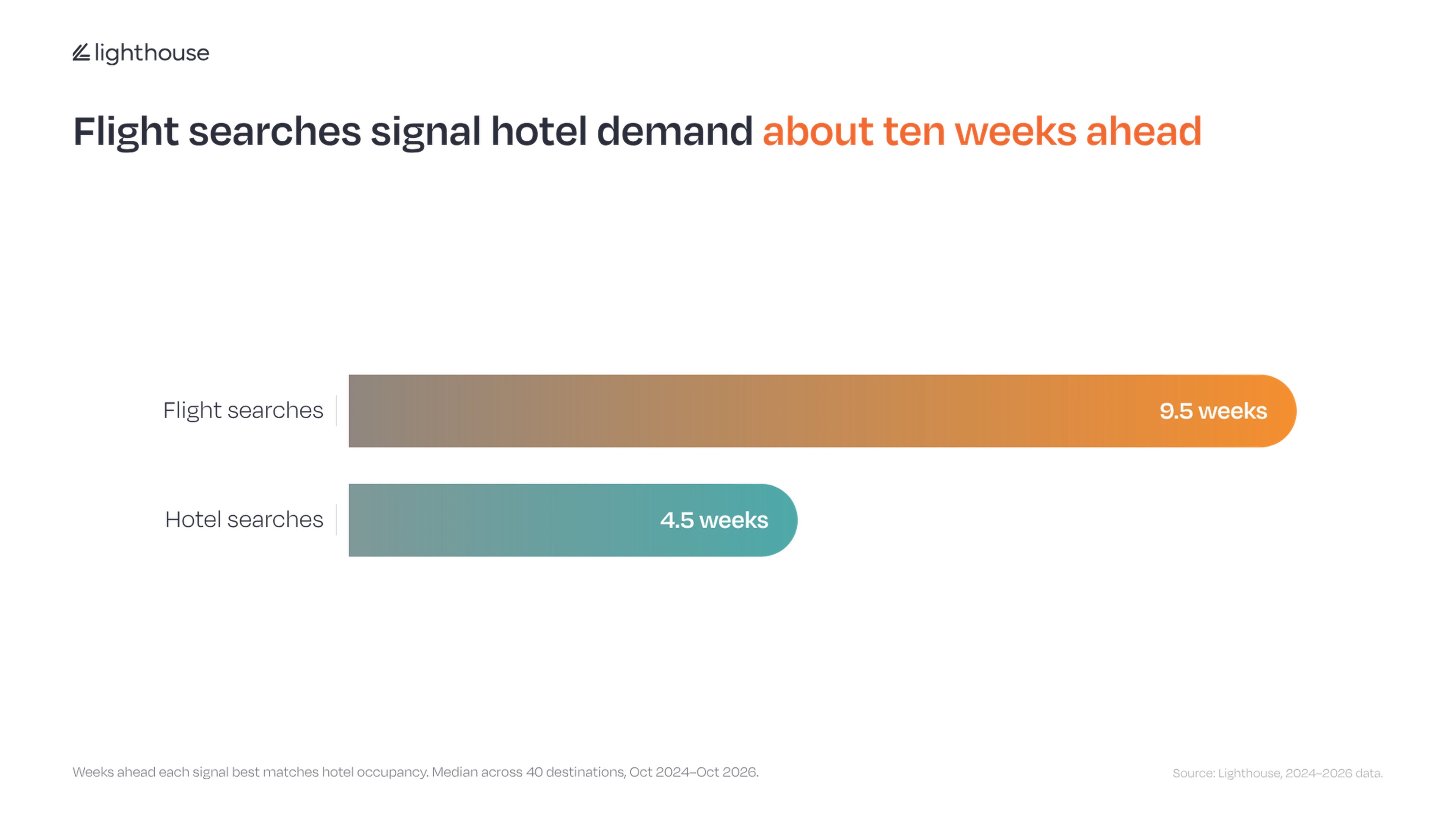
Lighthouse repeated the test with October 2024 to October 2026 data from 40 destinations, and the pattern held. Flight searches matched later occupancy most closely about nine to ten weeks ahead, and hotel searches about four to five weeks ahead.
The signal is strongest in leisure destinations. In Nice, flight searches tracked occupancy nine weeks later with a correlation of 0.89, while business hubs like London and New York showed the weakest link.
Events make the pattern easiest to see. Flight searches to Washington were 40% above the previous year 17 weeks before July 4, 2026, and occupancy on July 4 reached 98%.
Search data works best alongside historical data. History sets the baseline, and forward-looking searches show whether this year is moving away from it.
Do forward looking flight searches predict hotel demand?
Yes, they certainly do. In 2022, a Lighthouse study compared daily, weekly and monthly hotel performance with flight and hotel search data and found a positive correlation, high search volumes translated into high market demand and higher occupancy.
In Lighthouse’s Dubai example, searches for 26 June 2022 grew slowly, and market occupancy followed the same pattern, closing at 55%.
Post-pandemic extra layers of complexity were added to the demand forecasting process. In today’s dynamic market of geo-political shocks, hotel demand forecasting has become even more difficult. Historical data is less relevant, markets can change in the blink of an eye.
With predictive market intelligence built into your pricing solution, you can quickly grasp pre-booking market demand and take advantage of potential revenue opportunities before competitors.
Forward-looking search data enables you to view unconstrained demand in your market. You can then create precise forecasts, based on real-time demand projections, for more informed commercial decisions.
But, how far in advance can flight search data signify hotel demand?
How early can flight and hotel searches show signs of demand?
Lead times vary by destination and season, but for August 2022 stays in Singapore booked during August, Lighthouse data showed demand building 145 days earlier in flight searches and 80 days earlier in hotel searches.
In New York, searches for a June 2022 stay date first appeared 365 days before arrival.
Flight and hotel searches can occur days, weeks, or months before hotels see any reservations pick-up. But as mentioned an actual booking can vary depending on the destination and the seasonality.(For more detailed analysis of examples from around the globe, please take a look at the Lighthouse study.)
Search data offers an advanced window for hoteliers like you to revise your commercial strategy early on in the traveler’s booking journey and unlock previously unseen revenue opportunities.
This landmark study was conducted in 2022, four years on, does it still hold true?

Four years on what does flight search data tell us now?
Lighthouse repeated the test with live data. We compared weekly flight and hotel search volume in 40 destinations against the occupancy hotels actually achieved, from October 2024 to October 2026.
Flight searches matched later occupancy most closely about nine to ten weeks ahead, and later hotel rates about ten weeks ahead. Hotel searches matched most closely four to five weeks ahead. The order is the same as in 2022.
Flight intent still appears first, hotel searches follow and bookings come last.
The link is strongest in leisure destinations. In Nice, flight searches tracked occupancy nine weeks later with a correlation of 0.89, against 0.35 in the same week. It is weakest in large business hubs like London and New York, where hotels run close to full for much of the year.
Events show the pattern most clearly. Here are three from 2026.
Milan and the Winter Olympics
Hotel searches for Milan were 9% above the previous year in October 2025. By late December, six to eight weeks before the opening ceremony, they were running about 60% higher. Long-haul travelers sent the clearest flight signal.
In the three months before the Games, flight searches to Milan rose 20% from the US, 29% from Brazil and 42% from South Korea. Searches from nearby European markets barely changed.
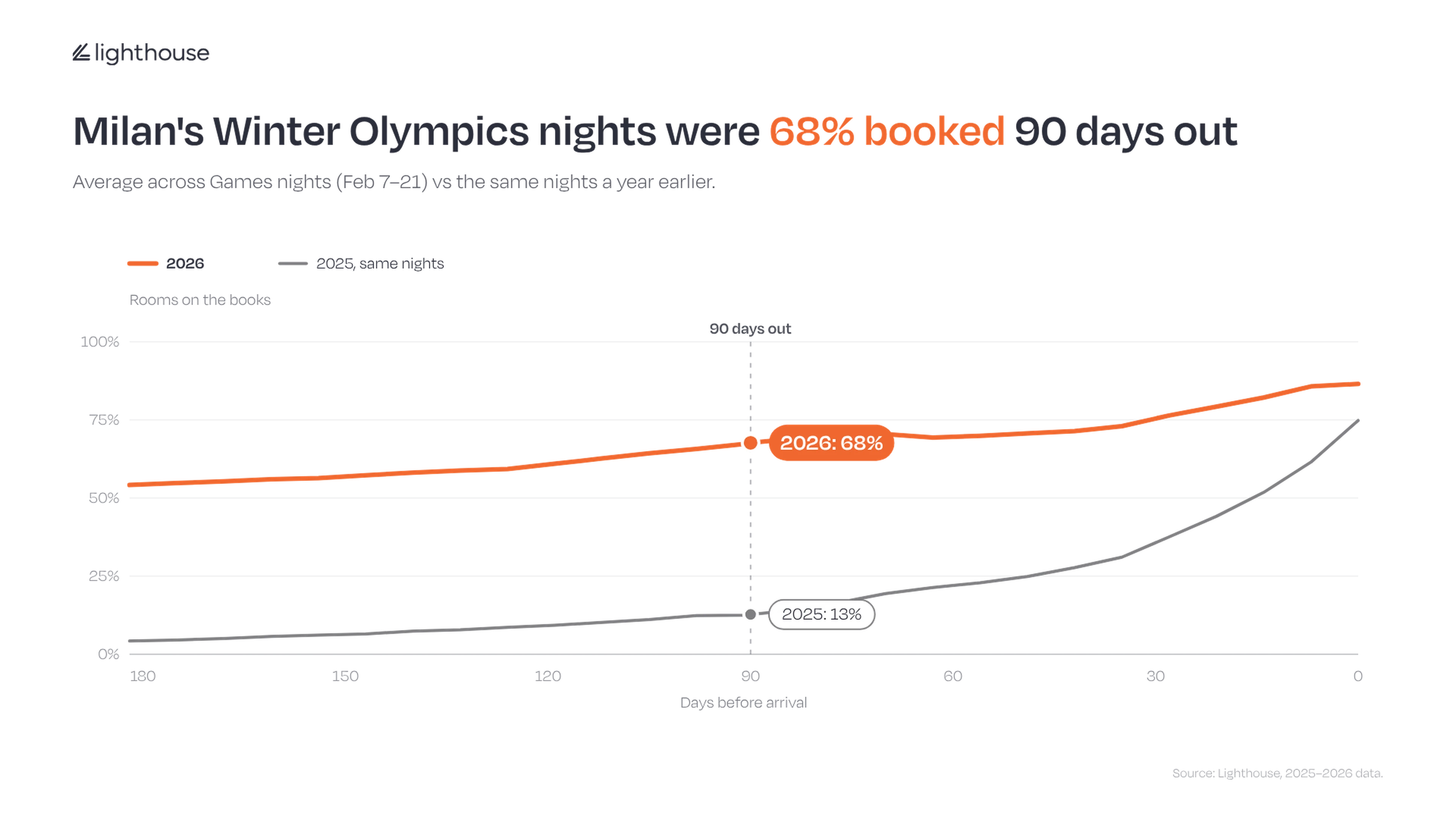
Hotels saw it in their books too. Ninety days before arrival, 68% of rooms for Games nights were already booked, compared with 13% for the same nights a year earlier. Ordinary dates in March paced within a few points of the previous year, so the gap belonged to the Games.
The lowest advertised rate across Games nights averaged $422, up 84% on the same nights in 2025, and some midweek nights went above $500. Final occupancy reached 86%, up from 73%. Rates for ordinary March nights were flat year over year.
Budapest and the Champions League final
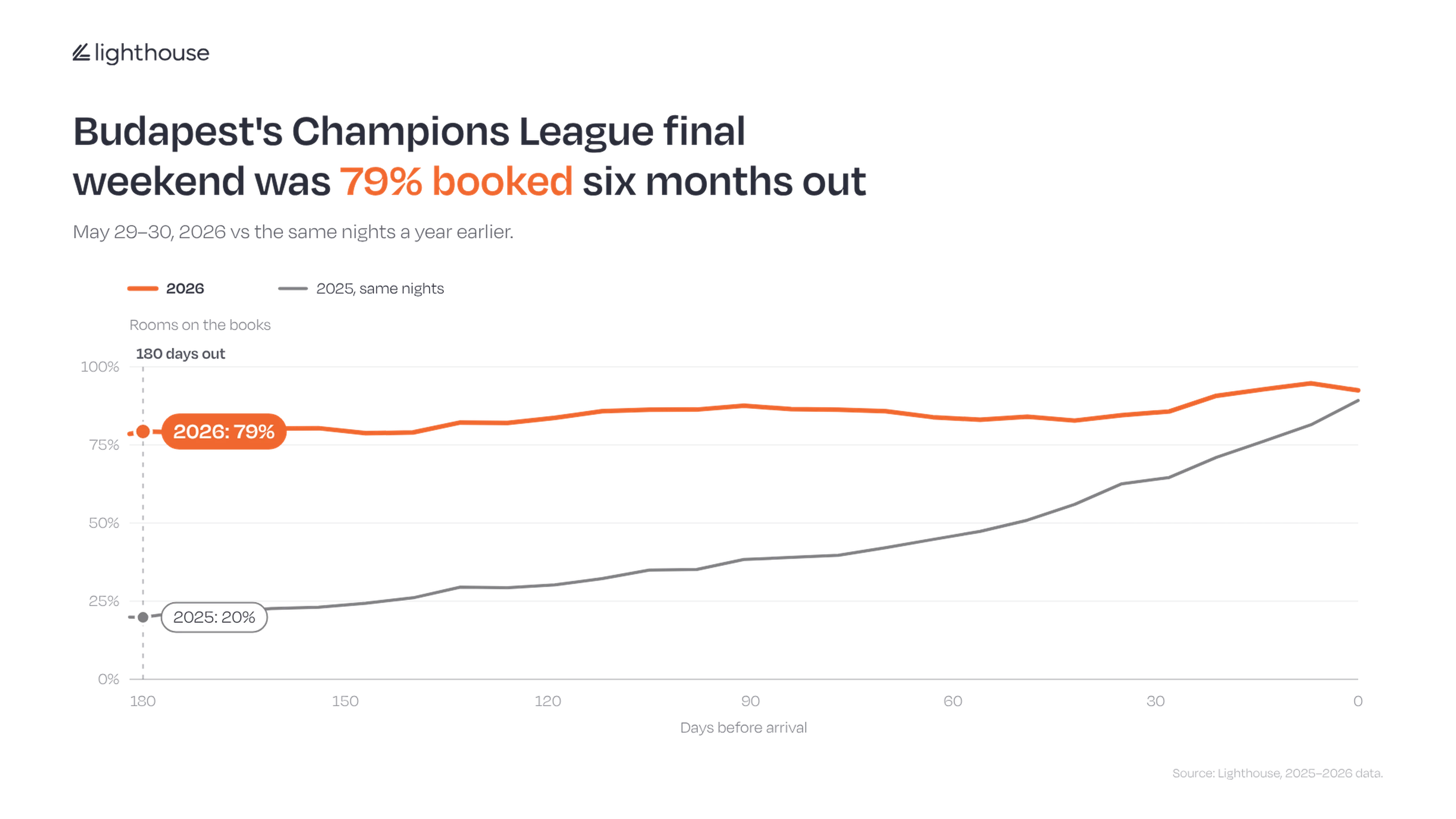
Six months out, Budapest hotels had 79% of rooms booked for the final weekend, compared with 20% for the same nights in 2025. When Arsenal and Paris Saint-Germain reached the final in early May, searches from both countries surged. In the week of May 11, flight searches to Budapest from the UK for travel within four weeks were four times higher than a year earlier. Searches from France were almost four times higher.
With most rooms already committed, that late wave of demand landed on a small pool of remaining inventory. The lowest advertised rate for the eve of the final was $429, up 124% on the same Friday in 2025. Ordinary March nights rose 7% over the same period. Budapest fills on late-May weekends in most years, so final occupancy barely changed (92% vs 91%). The event showed up in price.
Washington and July 4
This year’s July 4 marked 250 years of US independence. Flight searches to Washington were running 40% above the previous year in early March, 17 weeks out. They rose again in late April and early May, up 32% to 47%, nine to 11 weeks before the holiday.
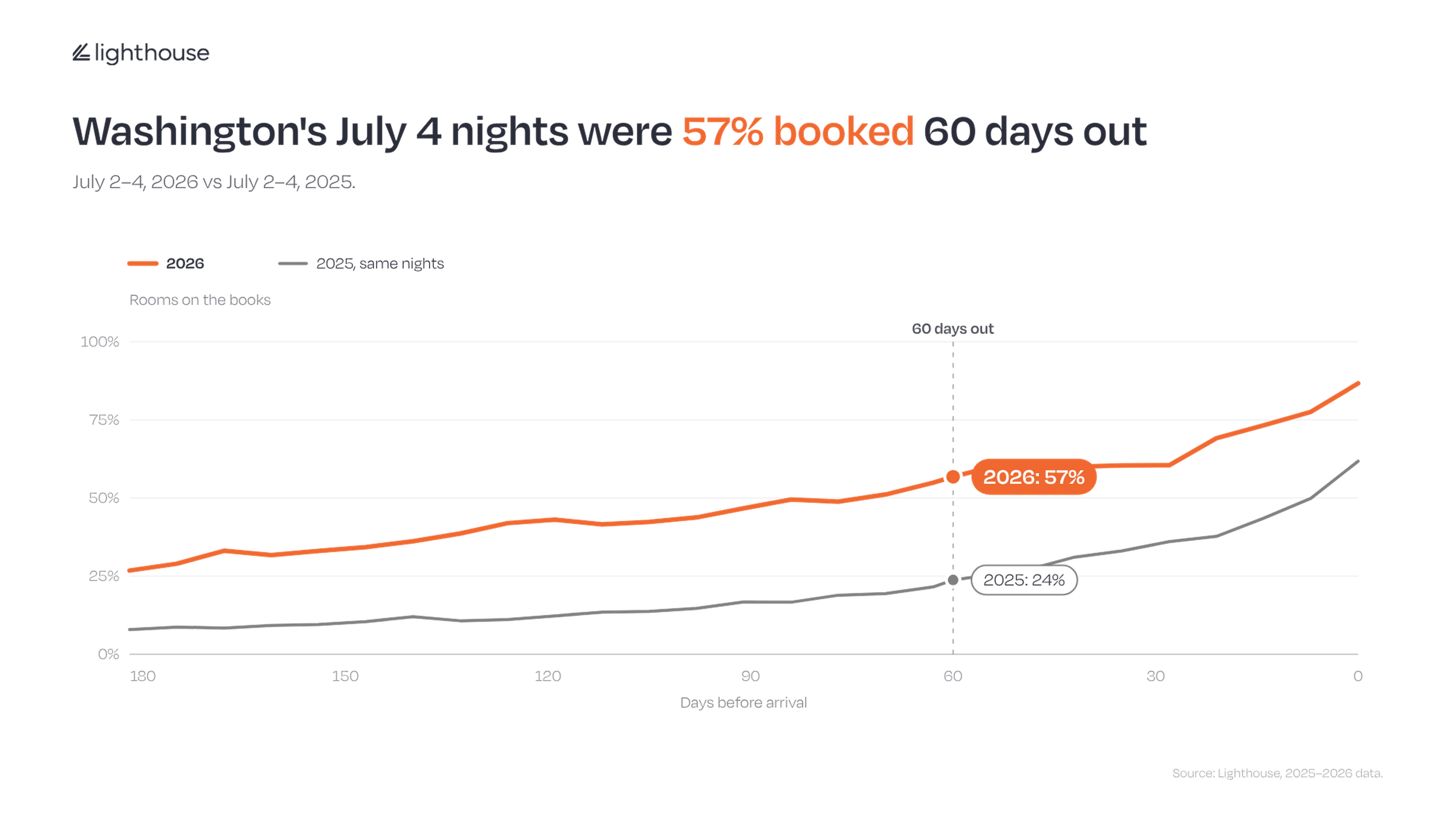
Bookings followed. With 60 days to go, 57% of rooms for July 2–4 were on the books, compared with 24% a year earlier. The lowest advertised rate for those three nights averaged $457, up 146%, and reached $602 on July 4 itself against $217 in 2025.
Final occupancy rose from 66% to 86% across the three nights and hit 98% on July 4. March rates were 3% lower than the previous year.
Forward-looking search data vs historical data: What does each tell you?
In short, historical data shows what demand was and what happened on past dates. Forward-looking search data shows what demand is becoming and what travelers are doing now for future dates.
Historical data
This is your booking history, occupancy, rates achieved, segment mix and pace curves, plus benchmarking against your comp set. It’s the most reliable data a hotel has because it records real transactions. It shows seasonality, how far out guests usually book, which segments fill which nights, and how you performed against the market.
The limitation is that it assumes the future will look like the past. It can’t see a new flight route, a concert announced last week, a competitor opening down the road, or a sudden drop in demand from one feeder market. It also hides unconstrained demand. If you sold out a night last year, your data shows the bookings you took, not the guests you turned away. Pricing off that history means you’ll probably underprice the same night this year.
Forward-looking search data
This captures travel intent before it turns into bookings, people searching for hotels and flights for future dates, where they’re searching from, and how far ahead. Because searches happen well before reservations, a revenue manager can see demand building (or fading) weeks before it shows up in pickup.
In practice it answers questions past data can’t:
Is interest in a specific date running ahead of or behind the same point last year?
Is a new event driving demand I hadn’t planned for?
Which source markets are growing or shrinking?
Are booking windows getting shorter or longer?
The caveat is that a search signals intent, and not every search converts. It works best as a directional signal read alongside your own pace and the market’s forward rates.
Commercial teams use them together to build the best possible picture of market demand. Historical data sets the baseline and forward-looking data tells you whether this year is deviating from it.
How should hotel commercial teams act on search demand?
Revenue management
Spot high-demand dates weeks before bookings arrive by tracking flight and hotel searches for future stay dates, giving you a head start on competitors still waiting for pickup.
Use search volume as a read on unconstrained demand, so you can price confidently on nights that sold out last year instead of repeating last year’s rates.
Compare search trends against your own pace and competitors’ forward rates to decide when to raise rates, tighten restrictions or hold steady.
Plan short, mid and long-term pricing using search lead times, adjusting strategy as booking windows lengthen or shorten.
Marketing
Target digital campaigns at the source countries, cities or airports where search demand is already building, so budget goes where travelers are already looking.
Time campaigns around rising interest in specific dates or events, launching offers while travelers are still deciding where to stay.
Shape offers around intended length of stay, such as extended-stay packages for markets planning longer trips.
Shift spend away from markets where searches are softening and toward emerging ones, improving ROI on every campaign.
Sales
Prioritize outreach to accounts and partners in the source markets showing the strongest growth in searches.
Use forward demand insights to decide when to accept or decline group business on high-demand dates, protecting space for higher-rated transient guests.
Bring search trends into conversations with travel agents and tour operators to support negotiations with real demand evidence.
Distribution
Work with key OTA and wholesale partners in high-growth source markets to focus visibility and promotional budgets where demand exists.
Align channel mix and allocations with intended length of stay and origin, so each partner gets inventory suited to the guests it reaches.
Spot weakening demand early and use partner promotions to fill soft periods before they become last-minute discounting.

How does Lighthouse Pricing bring together flight and hotel search data for you to drive better decisions?
Lighthouse Pricing combines forward-looking demand from flight and hotel search signals with real-time competitor rates for hotels and short-term rentals. Users can forecast market shifts 365 days ahead and drill into source markets, sub-locations and length of stay.
That means you are able to spot and target unconstrained demand before competitors start receiving the majority of their reservations. You can make the most of short, mid and long-term revenue opportunities with the appropriate pricing and marketing strategies.
See how you can get head start on the competition with Lighthouse Pricing.

Jonathan Gough
Frequently asked questions about flight search data to forecast hotel demand
Lighthouse Pricing tracks forward-looking demand up to 365 days ahead using real-time flight and hotel search signals. In a Lighthouse example from New York, searches for a June 2022 stay date first appeared 365 days before arrival.
It depends on the destination and season. For August 2022 stays in Singapore, Lighthouse data showed demand building 145 days earlier in flight searches and 80 days earlier in hotel searches.
Historical data shows what happened on past dates. Forward-looking demand data, such as flight and hotel searches, shows what travelers are planning now for future dates, so revenue teams can see changes before they appear in booking pace.
Yes. Lighthouse Pricing brings together flight and hotel search signals with real-time competitor rates for hotels and short-term rentals in one platform.
Yes. Lighthouse Pricing shows the source country, and in some cases the city or airport, behind searches, plus intended length of stay. Sales, distribution and marketing teams use this to focus partners and campaigns on markets where demand is already building.

Jonathan Gough
Jonathan Gough is Content Team Lead at Lighthouse, spearheading all things content marketing. With a marketing career of over a decade, dedicated solely to travel, tourism and hospitality, Jonathan is passionate about leveraging Lighthouse’s technology to move the sector forward and provide lodging professionals with the tools they need to grow their business.