Hotel booking trends 2026: Are shorter stays and last-minute searches the new normal?
:format(webp))
The global share of searches for one-night stays rose by 9% from Q1 2023 to Q4 2025, while the share of searches made for hotels within 28 days of the date of stay have likewise risen by 9% over the same period.
This marks a broad-based and persistent trend towards shorter stays and lead times over the last three years that shows no signs of disappearing in Q1 2026.
Travelers, especially in North America, appear to be shifting to a more flexible approach, likely driven by changing demographic, economic and technological conditions.
The extent of this trend, reaching across regions and across several years of data, shows how the hospitality industry needs to be proactively adapting. The hotel industry needs to embrace out-of-season travel, last-minute deals, changing search patterns, and dynamic pricing strategies to reflect a less predictable travel consumer.
Shorter hotel length-of-stays are on the rise
The data is unequivocal: average length-of-stay (LOS) is falling.
Driving this change is the increase in one-night hotel stays, searches for which have risen noticeably in our data over the last three years.
The share of searches for one-night-stays made on Online Travel Agencies (OTA) and metasearch sites has risen globally from 28% to 37% between Q1 2023 and Q4 2025.
At the same time, searches for stays of between eight and 14 days have declined, albeit at a much slower rate of change, declining from 8% of all searches in Q1 2023 to 6% in Q4 2025.
Critically though, the rise in shorter stays appears sustained and across a wide geographical range. The rise in searches for one-night stays has trended higher in every region aside from Asia, where searches for single night stays were already comparatively high.
Concurrently, searches of over eight days have declined in every region aside from Latin America.
The trend is especially pronounced in North America, where the share of searches for one-night stays has jumped dramatically from 31% in Q1 2023 to 56% in Q4 2025, a 25-percentage-point increase.
Overall, there is a striking trend of very short in well-developed travel markets, whereas growth markets appear to be transitioning slightly more slowly, with compression of intermediate length stays happening at a slower rate.
In Europe, the change in the share of single-night stay queries went from 39% to 20% between Q1 2023 and Q4 2025, a difference of 19% - while the comparable figures for Oceania were a rise from 36% to 45%, a 9% increase.
As noted, there was a decline in one-night stays in Asia between these two points, and a more modest 5% increase in Latin America and 7% in Africa and the Middle East.
Flight and hotel booking lead times gently decline
There has also been a small, but perceptible, shift in lead times for searches, with travelers looking at both flights and stays closer to the point of expected travel in 2025 compared to previous years.
This compression of the search window is more pronounced for stays than flights, with the latter generally booked first, and further in advance overall, reducing the impact of changing consumer search preferences.
At the same time, overall search volumes have not fallen but increased, indicating that travelers are not taking a devil-may-care approach, instead continuing to conduct considerable research, but pulling the trigger later.
Globally, the share of searches for flights made within 28 days of the stated departure date increased by 4% by Q4 2025 to a quarter of all searches.
For accommodation, searches made within 28 days of the stated arrival date rose 9% to 38% of all searches.
Once again, these changes were broad based, with decreasing lead times in almost all regions, Latin America being the most notable exception.
The biggest changes in the way travelers search for both flights and accommodation were experienced in Africa, Europe, the Middle East and North America.
From Q1 2023 to Q4 2025 flight searches made within 28 days rose:
Africa 6.2%
Europe 7.5%
Middle East 5.5%
North America 3.1%
While the same figures for accommodation were:
Africa 10.3%,
Europe 15.0%
Middle East 17.2%
North America 13.6%
These changes come alongside increasing search volume overall.
Searches for accommodation made on OTA and metasearch sites for European stays, the most popular destination globally for international arrivals, grew by 45% between Q1 2023 and Q4 2025, while flight search volumes rose 23% over the same period.
The combination of increased search volume overall, but a reduced window to do so indicates more intense searches by consumers for their journey and a greater focus on obtaining perceived value.
What’s driving the change in consumer travel behaviour?
The fact that we can see this trend developing across different regions and in different dimensions of consumer search behavior tells us that there is a clear shift underway, but what could be the drivers?
It seems likely that there are multiple factors at work that are combining to bring down duration of stay and shorten the booking pipeline.
Foremost among these are the changing economic conditions. Consumers have been squeezed in recent years, while continuing to prioritize travel as a key discretionary item. This is leading to households continuing to engage in leisure travel, but to economize with shorter trips and to hunt out deals wherever possible.
Forty-one percent of travelers in Criteo’s Winter 2025 Travel Pulse global survey of consumers said that rising travel costs were impacting their travel plans, compared to 19% who said that there was no effect.
Despite this, intention to travel remains, and consumers are prioritizing it within their household budgets. Klook’s Travel Pulse 2026 of 11,000 global travelers uncovered that 88% intend to increase or maintain travel budgets in 2026 and Criteo noted that 52% of consumers consider travel an essential compared to other lifestyle categories.
These competing aspects of pressure on household budgets but rising desire to travel are pushing consumers towards shorter trips at less popular times of year, and for those trips to be jam-packed to maximize value.
In an indicator of changing behaviors in action, we noted in our 2026 trends that off-peak travel was on the rise, with peak occupancy in Barcelona, Istanbul, London, Paris and Rome now coming in shoulder season rather than during the traditional August period.
Alongside this, Klook found that two thirds of travelers stated a desire to visit multiple destinations per trip.
Demographically, it is increasingly possible to engage in off-peak and more spontaneous travel. Traditional peak vacation periods are becoming less important as fewer households have children, either in the form of younger, childless households becoming more commonplace. Or in the rapidly expanding older demographic segments, which have largely seen improved economic fortunes over the last decade.
In the EU, there are 75 million single adult households without children, an increase of 17% in a decade. In the US the share of childless women rose by double digits in all age cohorts under 34, while East Asia has even higher rates of childless households.
Retirees are part of this changing demographic picture, making up a larger share of the population and also seeing their incomes and wealth rise over the last decade, increasing their capacity to spend on travel.
Finally, there is the changing role of technology in the travel funnel which is changing the booking experience and booking behavior. The rise of AI is allowing travelers to conduct more searches and gather information faster, increasing the potential to make last-minute bookings in confidence.
Search volume is going up, not down, as we noted above, while Criteo’s Q3 2025 research estimates that the average traveler goes through 25 hotel options before making their final choice.
In combination, an increasing share of travelers report using AI, with 51% of those polled in Klook’s survey saying they use it for travel research and 41% in Criteo’s research using it for accommodation research, up 4% YoY.
Put together, it’s clear that travelers are conducting more searches than ever, and doing more of that research with AI, which is altering the typical booking journey.
Spotlight on North America
The US is worth highlighting, not just as one of the world’s major travel markets, but also because it clearly shows these trends in action, especially with regard to very short stays.
While one-night stay searches rose substantially and continuously from 2023 to 2025, all other lengths-of-stay declined.
Overall, those one-night stops went from 30% of search volume in Q1 2023 to over 50% in Q4 2025 (52%). Americans were most likely to ditch four-to-seven-night stays, with the share of these lengths declining 10% across the period.
The trend for compression of the search and booking window for accommodation was also clearly apparent, although there was no concurrent change in flight search behavior.
Searches made within 28 days of the date-of-stay rose from 32% of US queries in Q1 2023 to 46% in Q4 2025, a change of 14%, and comparing Q4 2023 to Q4 2025 there was a more modest, but still noticeable, 6% increase.
Outside our proprietary data, Criteo’s survey also found an ongoing compression, particularly in the US. In their data, the share of US respondents who reported that they finalized their bookings within two weeks of the trip starting rose from 29% in Q3 2024 to 34% in Q3 2025, while the share doing so over two months after departing fell from 25% to 21%.
There was no comparable change in Asia, while in Europe the share completing their bookings within two weeks of departure increased 4% to 26% of respondents.
It is time for hoteliers to adapt to changing booking behaviour
These trends are not slowing down. Shorter stays, tighter booking windows, and a consumer who shops harder before committing; this is the baseline you are working with in 2026.
The question is whether you can see it happening in time to act.
When guests are booking later and staying fewer nights, the window to price correctly and capture demand gets shorter. Static strategies built on historical averages won’t cut it.
You need visibility into what’s happening in your market right now and the tools to act on it fast.
That’s where Lighthouse Pricing comes in. With guests booking closer to arrival, demand can spike and dissolve faster than traditional forecasting catches.
Lighthouse Pricing pulls together forward-looking flight and hotel search data, real-time competitor rates (including short-term rentals), and AI-driven pricing recommendations into a single workflow.
You can see a demand shift developing before it shows up in your on-the-books pace and respond with the right rate before your competitors do.
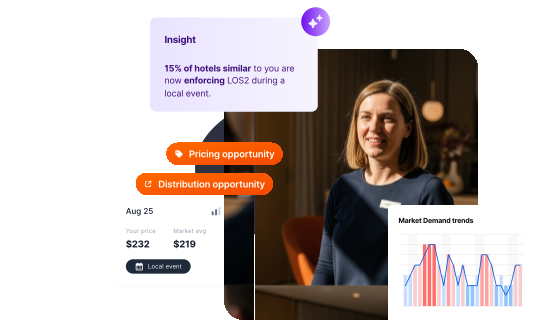
The insight-to-action lag is where revenue gets lost in a short-window market. Lighthouse AI Smart Insights feature closes that gap, so you can fully optimize rates. By scanning over three billion daily data points across the next 90 days, it surfaces demand changes, competitor sell-outs and pricing opportunities directly to your team, without anyone having to dig through dashboards to find them.
A revenue manager can walk in, see what’s changed overnight, and move. That’s the difference between reacting in time and missing the window entirely.
When you add in Lighthouse Performance you gain even more visibility. You can track how your booking curve is developing, segment demand by length of stay and lead time, booking channels such as direct bookings or OTA, and benchmark against your competitor set, all in near real-time.
When a shorter booking window means the next 28 days are your most critical trading period, having up-to-date business intelligence is essential to drive Average Daily Rate (ADR).
Lighthouse is the number one rated platform for hospitality decision makers. Discover how Lighthouse, with its AI powered insights can help you get ahead of a market that’s moving faster than ever.
Fique sempre à frente das mudanças do mercado
Receba gratuitamente o seu Painel de Alertas de Mercado, com preços da concorrência, demanda e eventos, personalizados para o seu hotel
Loading author...