FIFA World Cup 2026: FIFA room cancellations add pressure to already-soft hotel booking curves
:format(webp))
Booking pace for the 2026 FIFA World Cup is falling short of expectations. With FIFA releasing thousands of block-booked rooms back onto the market, hotels in host cities need to rethink their pricing and promotion strategies now.
In April 2026, stories circulated that FIFA had cut thousands of rooms from its World Cup block bookings across multiple cities. In other World Cups this would have been little more than an administrative headache, requiring inventory to be placed onto what should be a hot open market, but this time around it indicates bigger problems for North America’s hospitality market.
Booking curves aren’t seeing the bump you would expect from the globe’s biggest sporting event, only just pacing ahead of what we are seeing across the wider year.
Adding thousands of rooms hotels already hoped to have in the bag is far from ideal and it is clear that North American hospitality businesses will need to be highly responsive to make the most out of this year’s World Cup.
Key takeaways
FIFA has cancelled thousands of block-booked hotel rooms across World Cup host cities, adding supply into an already soft market.
The highest match-day OTB occupancy across U.S. host cities is just 42% (Boston), with some cities as low as 12%.
Five of seven host cities have cut average room rates since October, led by New York at -15%.
Booking pace has grown since October but remains well behind comparable benchmarks like Munich during Euro 2024.
Hotels still holding aspirational pricing risk empty rooms, so agile rate management and a pivot toward domestic travelers are now critical.
World Cup hotel occupancy: are booking curves where they should be?
In U.S. host cities, where we have a representative sample of on-the-books (OTB) data, we have extracted hotel occupancy figures, covering Atlanta, Boston, Dallas, Los Angeles, New York, San Francisco and Seattle.
Hotels in these cities were counting on the World Cup to fill rooms and push rates to annual highs. Current booking curves suggest they’ll need to reset those expectations.
The highest OTB occupancy for an opening match is in Boston: 42% of rooms booked on June 13. For closing fixtures, New York leads at 30% for the July 19 final.
The lowest match-day OTB occupancy sits at 12% in Atlanta and Seattle. Every host city has at least one match day with fewer than 20% of rooms sold.
None of this is what hotels expected when the tournament was awarded to the U.S. Or even 12 months ago.
And now FIFA has released thousands of its block-booked rooms back onto the market, with reported releases of 2,000 rooms in Philadelphia, 1,000 in Atlanta, and 800 in Mexico City, adding supply into a market that already has more inventory available than expected.
Hotel booking pace is growing, but is it fast enough?
A late surge isn’t impossible, but the pace so far has been slow and steady. Since our October analysis (before the full fixture list was released), average OTB occupancy has more than trebled across the host cities in our dataset.
The biggest jump is Seattle, where average occupancy has gone from 2% in October to around 25% today.
But even Boston, the most booked host city, still has an estimated 70% of inventory to sell. The opening match is weeks away, not months.
Comparing tournaments gives a sense of how far these markets still need to go.
Take Munich (Euro 2024 host city) and Philadelphia. They’re comparable in population, economy, hotel inventory and tournament role.
Munich’s short-term rental market hit an estimated 45% occupancy for final match days. Philadelphia is at 16%. A trebling from here is technically possible, but with most tickets already sold and the full schedule published, it would be unusual.
Some fans may be waiting for last-minute deals, but major events typically show tight inventory well before the two-month mark. With the opening match now inside that window, a dramatic surge looks unlikely.
A revenue readjustment for hoteliers?
Hotels are cutting rates. Five of the seven cities in our dataset have seen average room pricing fall since October, with only Dallas showing strong upward momentum.
Across those five cities, the average rate reduction is 8%, led by New York at -15%. New York remains the most expensive host city, but the average tournament-period rate has dropped from $583 to $494.
For major events, pricing curves often invert as the date approaches, so some discounting is expected. The real question is whether hotels are moving aggressively enough, given booking levels this low and hundreds or thousands of rooms re-entering the market after FIFA’s cancellations.
How should hoteliers respond to last minute changes in bookings?
The U.S. travel environment has been volatile. Changes to visa requirements, fees and vetting procedures have prompted 120 human rights groups to issue a travel advisory to fans.
FIFA has shifted its own ticket pricing strategy, and consumers across the board are dealing with affordability pressure.
All of this has reshaped the revenue outlook for host city hotels compared to previous World Cups. FIFA itself has downgraded upper-end ticket revenue expectations, with the Guardian reporting that 102 of 104 matches still had hospitality ticket availability as of early May.
In this environment, seeing what might happen closer to game day isn’t a strategy. You need to be agile, and act on pricing and promotions as soon as the chance arises.
If demand isn’t materializing at your current rate, you may have to consider lowering rates or offering promotional deals. Holding firm on aspirational pricing won’t fill rooms if the demand isn’t there. And with international visitor numbers tracking below previous World Cups, there’s a strong case for shifting promotional focus toward U.S. domestic travelers.
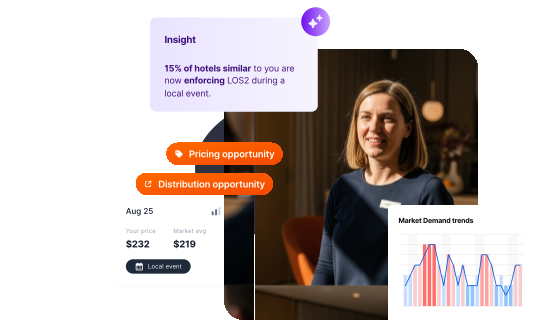
Lighthouse Pricing gives you forward-looking demand data, live competitive rate data and AI-driven pricing recommendations, so you can respond to shifting market conditions in real time.
Take a look at how it could works for a major event in your market.
市場の変化を見逃さないでください。
競合の料金、需要動向、ホテルに合わせたイベント情報を一目で確認できる、無料の マーケットアラートダッシュボード を今すぐ入手しましょう。
Loading author...