5 key steps to optimize your hotel website for AI search

Lighthouse data shows AI visit share to travel sites rose 194% year over year in 2026. On hotel websites, those visitors stay longer, visit more pages and convert 20% better into bookings.
AI is clearly transforming how people research, plan and book travel. Staying on top of this trend by implementing the steps from this guide determines whether AI recommends your hotel to travelers or not.
More and more travelers gravitate towards generative AI tools like ChatGPT and Claude to assist in trip planning. Their ability to provide straightforward answers to complex questions makes them function almost as a travel agent – only much faster.
At the same time, Google is accelerating the shift with its new AI Overviews. This built-in feature provides AI-generated summaries on top of the traditional search results that directly answer the user’s search query. This means users increasingly get answers without clicking through to websites.
So, how can you make sure your hotel or B&B appears front and center in AI answers and gets recommended to travelers? This guide shows you exactly how to adapt and optimize your website in 5 clear steps.
Key takeaways
AI search is the use of artificial intelligence tools such as ChatGPT, Claude and Google AI Overviews to answer natural-language travel queries with direct, conversational responses rather than a list of links.
Find out what your guests are searching: Research the real questions travelers ask about your property and destination using platforms like AlsoAsked and Reddit.
Refine and restructure your website content: Write in natural, conversational language that mirrors how people speak to AI tools and organize information under clear headings.
Add schema markup: Implement structured data code so AI models can read and categorize your content more accurately.
Answer frequently asked questions: Create a well-structured FAQ page addressing common traveler queries in a straightforward format.
Collect backlinks from reputable sources: Build authority by getting tourism boards, travel blogs and local partners to reference your website.
Lighthouse offers revolutionary tech to boost your hotel's AI visibility. Hotels using Lighthouse Connect AI see 21% more AI traffic on their website.
AI-referred traffic on hotel websites has 20% higher conversion into bookings.
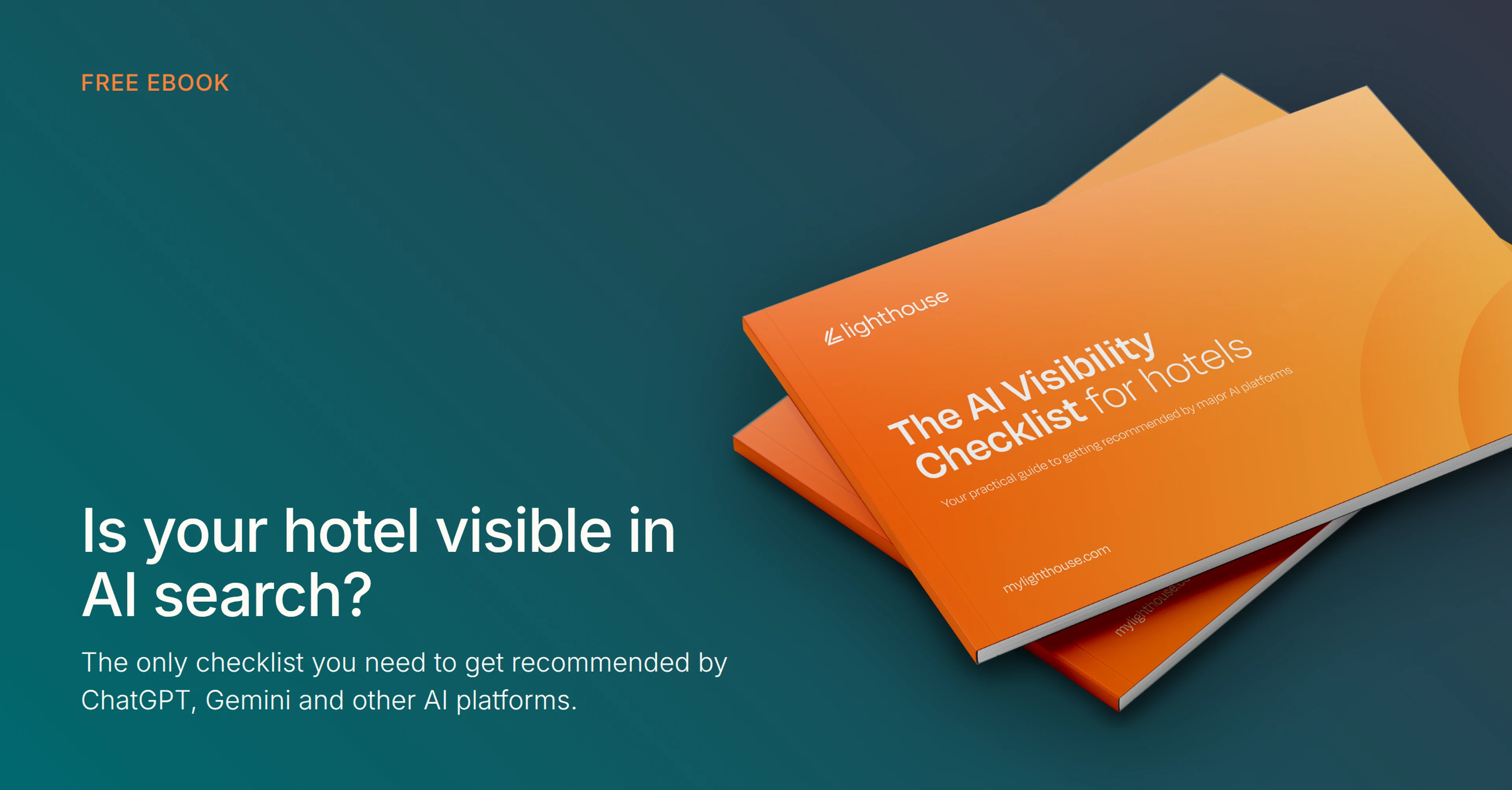
Download our practical AI visibility checklist to get started quickly on improving your website.
What is AI search and how does it work?
AI search tools – like ChatGPT and Claude, to name a few – leverage artificial intelligence, including machine learning and large language models (LLMs), to answer complex natural‑language queries such as:
“We’re a family with two toddlers visiting Lyon for a week. Where can we stay close to kid-proof outdoor activities?”
They are built to understand the deeper context and intent of the query, rather than just matching keywords like traditional search engines. They produce direct, conversational responses instead of a list of website links. Behind the scenes, many AI tools combine generation with retrieval. This means they pull information from trusted web sources and synthesize a response, often linking back to those sources.
AI search doesn’t replace your website. Think of it as a new channel next to traditional search results. It routes travelers to your site, provided your content is clear, well-structured and easy for AI models to understand.
Are you new to AI, LLMs and GEO? Discover everything independent hoteliers should know about AI here.
Why should hotels optimize their website for AI search?
The days of dismissing generative AI as a gimmick are well in the past. Just like regular search engines took the world by storm in the 90s, AI-driven search is rapidly transforming how users access information online. Adoption rates are rising fast and so is AI-referred website traffic.
AI visit share to travel sites is up 194% year over year in 2026, according to Lighthouse’s AI visibility checklist for hotels.
For hoteliers, this creates both a challenge and an opportunity. AI search offers a valuable new marketing channel that will not only name-drop your accommodation but also direct users to your website. Only, your current website may work for traditional search, but it isn’t necessarily optimized for LLMs and AI answers. Updating your site to speak “AI-friendly language” is the key to being found by future guests.
Google’s AI Overviews are blocking your hotel website traffic
A major factor driving the shift towards AI search is Google itself. With AI Overviews now live for all users, travelers are increasingly getting summarized answers directly at the top of the results page. This means that users don’t have to scroll through and click on links to find the information they need.
The implementation of Google’s AI Overviews has had a dramatic impact on organic traffic to websites across all industries. The silver lining is that AI Overviews not only cite but also link sources. If your hotel website provides well-structured, detailed answers to common queries, it’s more likely to be referenced and clicked on by potential guests.
Generative AI like ChatGPT is increasingly used for travel planning
It’s not surprising that more and more people are turning to established generative AI tools like ChatGPT, Claude, Perplexity and soon also Google’s upcoming AI Mode, for travel-related searches. After all, planning a vacation is a complex task that traditionally involves countless searches, browser tabs and hours of comparing options.
Based on a simple prompt, generative AI can provide travelers with:
Perfectly tailored recommendations
Detailed hotel comparisons
Complete itineraries including transport, activities and dining
Because of this, travelers are adopting fast. A survey of 1,000 travelers by Matador Network (2024) found that 22.8% have used AI and 34.4% intend to use AI to plan or assist with travel. According to Deloitte’s 2025 summer travel survey, 15% of Americans now use these applications in trip planning, compared to 10% in 2024. And it’s not just the youngest generation driving this trend.
Deloitte’s survey revealed that almost 1 in 4 American Gen Z’ers and Millennials turn to AI tools like ChatGPT for researching and planning trips. Gen X is catching up quickly: 13% have now jumped on the bandwagon, compared to only 7% last year. Boomers are slower to adopt AI search, with 6% of them using it for trip planning in 2025.
Percentage of people using generative AI tools for travel planning (Deloitte, 2025)
| 2024 | 2025 | |
|---|---|---|
| Overall | 10% | 15% |
| Gen Z | 13% | 23% |
| Millennials | 17% | 23% |
| Gen X | 7% | 13% |
| Boomers | 5% | 6% |
Across all generations, no less than 15% of Americans are relying on AI search platforms to help them with travel planning in 2025. That is a large chunk of your hotel guests. Nearly half of these travelers (46%) use it to explore accommodation options and 42% have actually booked based on these AI recommendations this year. Even more users research activities and attractions in specific destinations (61%) and destinations in general (48%) through their favorite AI search tool.
While Google’s Overviews can dampen website traffic, generative AI platforms like ChatGPT and Perplexity are driving new streams of traffic. In May 2025, AI-referred sessions were up 527%, according to Previsible’s AI Traffic Report.
That traffic also converts: visitors who arrive via AI view twice as many pages, spend twice as long on site, and hotel brands report 20% higher conversion from AI traffic than from other sources (Lighthouse, AI Visibility Checklist, 2026).

How can I check my hotel’s visibility in AI search?
How do you know if your hotel is already visible in AI search and if your optimization efforts are paying off? The key is to start measuring now and do regularly testing.
Ask AI tools the questions your guests likely ask, check whether your hotel is mentioned, how it's described and which sources are linked. Does it send travelers to your own website or to an OTA? You can also track AI-referred traffic in your analytics. For easy monitoring and optimizing, use Lighthouse Connect AI, which scores your AI readiness from 0 to 10 and tells you exactly what to fix next.
Here’s how to monitor your hotel's AI visibility:
1. Run a monthly AI visibility check yourself
Open ChatGPT, Perplexity, Gemini and Google AI Mode in a logged-out or incognito window so your previous searches can't influence the answers. Ask five to ten questions the way a traveler would, without naming your hotel. For example:
“Where should I stay in Venice if I arrive by train and want to walk everywhere?”
For each answer, note three things: is your hotel named, where does it rank and which sources does the AI cite? Keep the results in a simple spreadsheet and repeat the same prompts every month. If you don't appear in the AI answer, that tells you which questions your website isn’t answering.
2. Track AI-referred traffic in your website analytics
AI platforms send visitors to hotel websites, and that traffic converts well: hotel brands report 20% higher conversion from AI traffic than from other sources (Lighthouse, AI Visibility Checklist, 2026). In Google Analytics 4, create a segment for sessions whose referrer is an AI platform, such as chatgpt.com, perplexity.ai or gemini.google.com. Watch how that number moves over time.
3. Get an AI Readiness Score
Connect AI by Lighthouse is built to give you insight into you hotel's AI visibility, improve it and drive direct bookings from AI search.
The AI Readiness Score rates your hotel website from 0 to 10 on how AI-ready it is and benchmarks you against the Lighthouse network of 80,000 hotels. It then gives you a optimization plan, with priorities, quick wins and bigger tasks, refreshed every week.
Alongside the score, AI Visibility Insights show how often your hotel is mentioned by AI, how you compare to competitors, which sources are used and whether travelers are referred to your website or to OTAs.
The best part: hotels using Connect AI see 21% more AI traffic on their website than hotels without it.
How to make your hotel more visible on ChatGPT and other AI search platforms
As AI searches are increasingly replacing traditional ones, hoteliers need to update their website in order to be found by potential guests. But, how do you ensure your property is referenced there?
Here’s the truth: Your current website setup isn’t built with LLMs in mind. It’s designed to be found by traditional engines like Google. While SEO (Search Engine Optimization) remains important, it won’t help your visibility in AI environments. Let’s dive into the five key steps you need to take in order to successfully adapt and optimize your website for AI search.
Step 1: Find out what your guests are searching
How do you find what guests are searching? Start by researching the real questions travelers ask about your property and destination.
The first logical step is finding out what real questions travelers are asking about your property and destination. Research tools like AlsoAsked, Answer the Public, Google’s People Also Ask, Perplexity, Reddit and Quora are goldmines for gaining insight into these queries.
Once you know what people are asking online, you can create dedicated sections on your website that answer those questions directly.
Key takeaway: Use tools like AlsoAsked and Reddit to uncover the exact questions travelers ask, then answer them on your site.
Step 2: Refine and restructure your website content
How should you write content for AI search? Write in natural, conversational language that mirrors how travelers actually speak to AI tools.
The way users interact with AI engines like ChatGPT varies greatly from how they search on Google. They use longer queries that closely resemble the way they speak to a real person, either in the form of a full-sentence question or a statement followed by a request (prompt).
Generic search query vs. AI search query
| Generic search query | AI search query |
|---|---|
| family hotel venice | What are the best-rated family hotels in Venice with amenities for young children? |
| family hotel with pool venice | I’m planning a family trip to Venice. Can you show me the best-rated hotels that have a pool and amenities for young children? |
Rather than staying limited to a couple of keywords, AI search queries look like natural conversations. To increase your AI mentions, your website content should follow the same tone. Don’t just focus on keywords, but write in natural language that mirrors AI queries and answers. A great tactic is incorporating common conversational or question-based queries into your headings (titles). Provide a clear and concise answer immediately after these descriptive headings – ideally in 60 words or less – and elaborate in the following paragraphs.
Elaborating is key, because for AI search, the devil is in the details. Therefore, include detailed descriptions of amenities, services and unique offerings in a way that sounds human and engaging. Group them per theme, giving each section a clear, descriptive heading that closely matches the search query. Include bulleted lists when relevant to provide even more detail or clarity. Adding information coming from credible sources – like guest reviews or stories – increases your chances of being cited by AI as well.
Don’t limit your website content to your property. Be sure to add highly-searched information about your destination too. For example, a web page about nearby attractions and activities might contain a section titled: “What to do and see in and around Lyon?”. You can further split these up per target audience: families, couples, friend groups, solo travelers, … The possibilities are endless, as long as you bear in mind what travelers are actively searching online.
Quick checklist for AI-friendly copy:
Use natural, conversational language: Write the way guests actually speak when asking questions, not in stiff marketing-speak.
Avoid keyword stuffing: AI tools prioritize helpful content over pages crammed with repetitive phrases.
Add details and rich context: Specific information about room sizes, amenities and local attractions helps AI generate accurate answers.
Incorporate quotes and stories from staff and guests: Real voices add credibility that AI systems recognize and value.
Use headings that mirror search queries: Frame section titles as questions travelers actually ask.
Organize information in lists and tables: Structured formats are easier for AI to parse and cite.
Answer questions directly and thoroughly: Lead with the answer, then elaborate with supporting details.
Group related topics logically: Keep similar information together so AI can understand the full context.
Include relevant synonyms naturally: Variations help AI match your content to different phrasings of the same query.
Avoid conflicting or outdated information: Inconsistencies confuse AI and reduce your chances of being cited.
If keywords are the foundation of SEO, structure is the cornerstone of AI search. The way you structure information determines if it gets picked up by AI or not. Ensure all your website content is logically structured under headings and subheadings, applying the appropriate formatting to each title (H1, H2, H3, H4 …).
When your website content is clear, detailed and well-structured, AI platforms are far more likely to reference and send traffic to your site.
Key takeaway: Write naturally, structure content under clear headings and answer questions directly in the first 60 words.

Step 3: Add schema markup
What is schema markup and why does it matter? Schema markup (also called structured data) is code you add to your website that helps AI models and regular search engines understand and categorize your content more accurately.
By adding this code to your web page HTML, you can provide explicit context and label different elements on the page, making it easier for engines to read and categorize. Your content not only becomes more accessible to AI search engines, but will be presented more accurately in their answers.
Major AI search players Google, ChatGPT and Microsoft have all stressed the importance of structured data, claiming their engines use it to reference websites and products. There is no doubt that implementing it can only benefit your hotel’s exposure in AI-generated answers.
This is a high-effort tactic, but one with equally high impact. While you don’t need a degree in programming, you will need to do a bit of reading before getting started. Both Schema.org and Google’s structured data help articles provide in-depth information and step-by-step guides. If you feel overwhelmed, ask your webmaster or your go-to AI tool for help or instructions.
How to add schema markup to your hotel website:
Prioritize adding schema markup to these pages, if your website has them: FAQ, contact, location, guest reviews, rooms, offers, blog articles, terms and conditions, and any other highly informative pages.
Use the Schema.org library and templates or Google’s Structured Data Markup Helper to generate the needed code. Alternatively, ask your webmaster for help. The four schema types that matter most for hotels are Hotel, LodgingBusiness, AggregateRating and FAQPage (in JSON-LD format).
Copy the schema code and paste it in the HTML of your web pages, or ask your webmaster to do this.
Use Google's Rich Results Test and Schema Markup Validator to test and validate your schema before publishing.
Key takeaway: Add structured data code to key pages so AI tools can read and cite your content accurately.
Step 4: Answer Frequently Asked Questions (FAQs)
Why do FAQs matter for AI search? AI-powered engines favor the clear, structured format of FAQs because it helps them generate accurate answers to user queries.
If you haven’t already, create a well-structured, extensive FAQ page on your website to address relevant questions in a straightforward way. Refer back to your findings in the first step of this guide: What are potential guests asking about your accommodation, destination, region and country during their research or planning phase? You can also address some of these queries in dedicated FAQ sections on other web pages if that makes more sense.
You can also start from your accommodation’s unique assets and incorporate them into FAQs: large outdoor or indoor swimming pool, proximity to the airport and public transport, special deals …
For example:
Query: Do you need an emissions sticker for Lyon?
FAQ: Do you need an emissions sticker for Lyon? Yes, you need an emissions sticker to enter Lyon by car. We recommend registering well in advance via …Query: Which hotels in Venice are easily accessible from the airport by public transport?
FAQ: Is Hotel Lighthouse easily accessible from the Venice airport by public transport? Yes, Hotel Lighthouse is easy to reach by train and bus from the airport in less than 30 minutes. (Make sure to include further details about the train/bus guests can take.)Query: Are pets allowed in Hotel Lighthouse?
FAQ: Are pets allowed in Hotel Lighthouse? Yes, pets are welcome to stay at Hotel Lighthouse. We just ask that you inform us in advance if you plan on bringing your furry friend.
Don’t forget to give these Q&A sections the right formatting, structure and schema markup (see step 2 and 3 above).
Key takeaway: Build a comprehensive FAQ page that directly answers the questions travelers are already asking online.
Step 5: Collect backlinks from reputable sources
How do backlinks help with AI search? When authoritative sources like tourism boards, travel blogs, local vendors, news outlets and review sites link to your website, it signals to AI that you're a trustworthy source worth citing.
Produce original articles that are likely to get picked up by different outlets. These blog posts might include: trying and rating local food, uncovering the latest travel trends, visiting new attractions in your region, … Additionally, invest some time in PR (public relations) whenever you have exciting or fun news to share. Has your property undergone a full renovation to be more eco-friendly and provide more comfort to guests? Has your team participated in a charity initiative? Are you hosting your own event soon? Let the world know!
Lastly, establish partnerships with local businesses and refer to each other’s website along with a positive, detailed description. Aim for contextual links to relevant web pages, not just your homepage. If you want to take it one step further, you can look into influencer marketing and sponsorships to get your property talked about online.
How to establish backlinks to your hotel website:
Partner with tourism boards, local vendors and travel blogs
Publish original articles about local food, events or trends that others will cite
Share newsworthy updates through PR (renovations, charity initiatives, events)
Collaborate with local businesses and cross-link your websites
Explore influencer marketing or sponsorships
Key takeaway: Build authority by earning links from tourism boards, travel blogs and local partners who vouch for your property.
Bonus tip: Look beyond your hotel website
LLMs don’t just pull information from websites, but from various online sources. Think social media platforms like LinkedIn and Facebook, OTAs, forums like Reddit and YouTube. Therefore, having a strong online presence across a variety of platforms is key.
If you haven't already, start by creating profiles on these platforms:
LinkedIn: AI tools frequently cite professional profiles; a complete company page adds credibility and helps AI verify your property exists.
Google Business Profile: Essential for local search and AI answers; keep hours, photos and descriptions current.
TripAdvisor: One of the most-cited platforms by AI tools; detailed listings and fresh reviews boost your visibility.
Next, start strengthening your presence on platforms that revolve around user-generated content. Social network sites YouTube and Facebook, as well as popular forums like Reddit and Yelp feature numerous travel-related recommendations and reviews from real people – information that is extremely valued by AI search engines. Set up your own accounts and get your hotel talked about on these sites to increase your chances of being mentioned in AI answers.
Make sure all your OTA listings are up-to-date, complete and consistent. Include all relevant information that travelers are frequently looking for: pet-friendly, free parking, on-site dining … Pay special attention to your profile on review website TripAdvisor, one of the most cited platforms by AI tools, ranking behind Reddit, YouTube and Yelp.
The stronger and more consistent your digital footprint, the more likely AI is to surface your property in answers.
Use AI to your advantage
A large chunk of leisure travelers are using AI search for trip planning, yet hotel brands currently lack visibility in the answers generated. This is your time to act. You now have the opportunity to gain a competitive edge and optimize your online presence for AI.
Following these five steps allows you to increase your hotel’s visibility in AI answers, attract more travelers to your website and – ultimately – boost bookings. Don’t view AI as a threat, but as an opportunity to get ahead of your competitors.
If you wish to know more about leveraging AI search tools as an effective direct booking channel, download our new AI visibility guide packed with practical advice and research insights.

Lighthouse brings AI to independent hoteliers
Just as AI transforms the way hotels are discovered and booked, Lighthouse’s AI-powered platform is redefining how independent hoteliers run their property.
From optimizing your prices, promotions and inventory on OTAs to simplifying your day-to-day operations – Lighthouse enables you to leverage AI automation with ease. That way, you not only see your revenue grow, but you win back time to focus on what actually matters: guest service.
Our revolutionary AI visibility solution, Connect AI, turns AI searches into bookings. It bridges the gap between hotels and AI-powered travel planning platforms, ensuring your property is discoverable and bookable directly through those systems. Hotels using Lighthouse Connect AI see 21% more AI traffic than those that don’t.
Lighthouse isn’t just keeping pace with the industry – it’s actively shaping what’s next in hospitality. If you’re ready to explore how our AI-driven solutions can help you compete successfully in this rapidly evolving landscape, get in touch with one of our team members today.
Hotel AI search – FAQ
How do I get my hotel to show up in AI search?
Make your website easy for AI to read and cite: research the questions travelers ask, answer them directly under question-style headings, add schema markup, build an FAQ page and earn links from tourism boards and travel sites. Keep your Google Business Profile, TripAdvisor and OTA listings complete and consistent, because AI tools frequently pull from those.
How do I optimize my hotel website copy for AI search?
Focus on writing clear, conversational content that directly answers the questions travelers ask. Structure your pages with descriptive headings, add schema markup to help AI understand your content and build a comprehensive FAQ section.
What content changes help a hotel website show up in AI?
Write the way guests ask questions, lead each section with a direct answer of 60 words or less, and group details about rooms, amenities, policies and the local area under clear headings. Add lists, tables, guest quotes and highly specific facts such as distances and check-in times. Remove outdated or conflicting information, which lowers your chance of being cited.
How can I monitor my hotel website’s visibility in AI searches?
Once a month, ask ChatGPT, Perplexity and Google AI Mode five to ten traveler-style questions about your destination in an incognito window and track AI-referred visits in Google Analytics. Lighthouse Connect AI automates this with an AI Readiness Score from 0 to 10, AI Visibility Insights and a weekly optimization plan.
Does schema markup really help with AI search?
Yes. Google, ChatGPT and Microsoft have all confirmed they use structured data to understand and reference website content. Adding schema markup to your key pages makes it easier for AI to accurately cite your property.
What questions should I include in my hotel FAQ?
Start with the queries you discovered in your research — questions about parking, pet policies, airport access, local attractions and amenities. Also address destination-specific questions like visa requirements or public transport options.
How long does it take to see results from AI search optimization?
AI models update their knowledge bases periodically, so changes won't appear instantly. Focus on building a strong foundation now; most properties see increased AI visibility within three to six months of consistent optimization.
Do I need to hire a developer to add schema markup?
Not necessarily. Tools like Google's Structured Data Markup Helper can generate the code for you. However, if you're uncomfortable editing HTML, asking your webmaster or a freelancer to help is a worthwhile investment.
Are paid AI search optimization tools worth it, or just hype?
Tools like Connect AI by Lighthouse help you improve your website for AI search, make your hotel directly bookable and save you time on monitoring AI visibility. Before paying for any tool, test whether your hotel appears for the prompts travelers actually use and track AI-referred bookings in your analytics, so you can judge the return.
Which platforms matter most for AI visibility besides my website?
Google Business Profile, TripAdvisor, Yelp, Reddit and YouTube are among the most-cited sources by AI tools. Keeping these profiles complete, current and active significantly increases your chances of being mentioned in AI answers.

Laure Cremers

Laure Cremers
Laure Cremers is a senior content specialist at Lighthouse with a focus on hospitality technology for independent hoteliers and B&B owners. Passionate about spotting new trends in the industry, Laure simply loves translating insights into actionable tips for hospitality professionals to boost their efficiency and profitability.