The ultimate guide to AI software for small hotels: Simple steps, real results
:format(webp))
It’s easy to feel overwhelmed by artificial intelligence or AI, but making it work for your hotel doesn’t have to be hard if you take it step by step.
If you run an independent hotel or B&B, AI can easily sound like something that is too expensive, too technical or simply not made for a property like yours. When you’re already busy managing pricing, guest messages and daily operations, the last thing you want is another system to manage.
In reality, AI is simpler than it sounds. Think of it as your background support, taking care of the difficult, repetitive and time-consuming work that usually eats into your day.
It’s designed to support your decisions, not replace them. You stay in control of your strategy and guest experience, while AI automation takes care of the tedious tasks that pull you out of running your hotel and into spreadsheets.
The truth is, many independent hotels are already using AI without realizing it, often through pricing tools, automated guest replies and channel management systems.
When applied gradually, AI does not have to add complexity or cost. It takes pressure off the day-to-day work, supporting your work behind the scenes, while the personal guest experience stays firmly in your hands.
AI won’t run your hotel. It just gives you more time back.
This guide will tell you exactly how you can adopt it and get real results fast, without radically changing your entire way of working overnight.
What AI actually means for independent hoteliers
Let’s clear up a common misconception first. AI in hospitality is not about robots replacing your staff or taking over how your hotel is run. In short, AI is a digital assistant that reduces the manual effort behind everyday decisions, so pricing, availability and guest communication don’t depend on you finding some spare time.
That only works if you’re clear on what AI is good at, and where human judgment still matters. At a practical level, AI does three things well:
Pattern recognition: AI is good at spotting gaps and changes in large amounts of data that are easy to miss when you’re busy running the hotel. For example, shifts in demand, competitor rates moving or booking patterns starting to change. That means you’re not reacting after the fact, or relying on guesswork and outdated spreadsheets to make key decisions.
Automation of repetitive decisions: Tasks like adjusting rates, answering the same guest questions or triggering email workflows can be handled automatically, based on rules you define. That removes the need to constantly check and update things yourself while keeping you firmly in control, and ensures consistency even when things get busy.
Smart recommendations: Rather than making decisions for you, AI suggests actions and explains the reasoning behind them. You remain in control, basing your strategy on data rather than gut feeling or competitor moves.
For independent hotels with limited staff and time, every pricing decision, missed opportunity or manual task add up quickly. When AI takes repetitive work off your plate and helps you act faster, the impact is felt almost immediately.
At the same time, human judgement remains essential for reviewing AI output, overriding them when needed and delivering the personal guest experience that defines an independent hotel.
:format(webp))
Where AI delivers the fastest wins for independents
Not every AI tool delivers the same value. For independent hotels, the biggest gains usually come from a few areas in particular. These are the parts of the operation where manual work, interruptions and uncertainty are common.
Guest communication and chatbots
“I’ve answered the same guest question 12 times today”
Guest communication is often where results become visible immediately. AI-assisted email flows can automate communication across the entire guest journey, without requiring constant manual intervention:
Pre-arrival emails can share practical information, set expectations or promote extras.
In-stay messages can highlight services or local tips.
Post-stay emails can request reviews and encourage repeat bookings.
Because these messages are triggered by booking data and guest behavior, communication stays timely and relevant, while your team saves hours of repetitive work.
Alongside email, AI-powered chatbots on your website or WhatsApp can handle guest inquiries around the clock, even outside office hours. Common questions about availability, parking, breakfast times or cancellation policies no longer need a manual reply each time. These are the same interruptions that typically pull staff away from the guest in front of them.
Today’s smart chatbots even go beyond basic FAQs. They actively guide visitors toward booking by sharing availability, linking directly to your booking engine and reinforcing book-direct benefits at the right moment.
Together, automated email flows and chat create a more responsive and professional guest experience, even with a small team, while freeing up staff to focus on the moments where personal interaction matters most.
Revenue management and pricing
“I don’t know if I’m underpricing or overpricing. I just follow my gut.”
Pricing is another area where AI can deliver real results fast, especially for small teams. Many independent hoteliers spend late evenings manually checking competitor rates, monitoring demand and adjusting prices across channels. It not only takes time, but you still risk missing opportunities due to outdated information and inevitable guesswork.
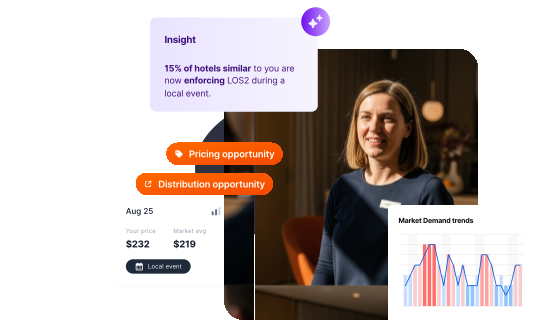
AI-assisted dynamic pricing tools for hotels continuously analyze demand trends, local events, competitor behavior and your own occupancy to recommend optimal rates.
For independent properties with a strong distribution mix, pricing is often one of the fastest ways to improve hotel revenue. Instead of reacting late to changes in demand or pricing too cautiously, AI allows you to respond in real time while staying within the pricing rules and strategy you set.
The aim is not to give up control, but to price with greater confidence, supported by data rather than gut feeling.
If you've ever looked at your occupancy numbers and wondered why this week feels slower than the same week last year, the answer is usually in the market data – you just need a way to see it clearly. Lighthouse's free Market Alerts dashboard gives you 90 days of demand, rate and local event data in one place, so you can spot patterns and act on them before the window closes.
Get your free Market Alerts dashboard.
Distribution and visibility
“I need better online visibility, but don’t want to add more channels.”
OTAs sometimes feel like a double-edged sword. Adding more booking channels increases visibility, but it can also bring more work and commission. For many independent hoteliers, the instinctive response is to stick to one or two big global OTAs like Booking.com and Expedia. But relying too heavily on those few channels can actually hurt profitability.
At the same time, adding more channels to manage manually isn’t realistic. It quickly becomes time-consuming and can increase the risk of inconsistent room rates and availability, leading to errors like overbooking.
This is where AI-driven pricing and channel management come together. Lighthouse software doesn’t just prevent overbookings by synchronizing your availability. It uses AI to keep your prices optimized and aligned everywhere, while balancing your channel mix to reduce commission, automatically.
Instead of simply adding channels for the sake of reach, Lighthouse helps you make your channels work harder for your bottom line. You become more visible, reduce reliance on high-commission OTAs and prioritize more profitable bookings, all without adding to your workload.
Aside from Google and OTAs, keeping your booking channels in sync also benefits your hotel’s visibility within AI search engines like ChatGPT. This matters, as travelers increasingly use these tools to find and compare accommodation options. If your information is accurate and consistent, your hotel is more likely to be mentioned and recommended.
Personalization and review management
“I don’t have time to send guests personalized messages or reply to reviews consistently.”
Once the basics are in place, AI can also support more effective guest communication and review management.
Modern hospitality CRM (Customer Relationship Management) systems can segment your guests based on their booking history and behavior using AI. This allows you to send highly targeted and effective messages; think pre-arrival upsells, post-stay review requests or direct booking incentives for repeat guests.
Routine reviews can be handled automatically, while more sensitive feedback is surfaced quickly so you can respond personally, without digging through everything yourself.
For independent hotels, it allows guest communication to stay personal without turning email marketing into something you have to manage by hand. Campaigns can run automatically in the background, while still feeling tailored and thoughtful to guests.
Operations and service
“My front desk gets overloaded sometimes, but I don’t want to lose our personal touch.”
On the operational side, AI and automation take pressure off small teams by streamlining daily tasks. And when hotel operations run smoothly behind the scenes, guests feel it too.
AI-driven tools use occupancy forecasts and check-in patterns to automate housekeeping planning and other operational tasks. Instead of chaotic spreadsheets, notes and last-minute changes, you get clear, up-to-date lists that help distribute work more evenly and reduce stress during busy periods.
AI can also support guest service without replacing personal service. Messaging tools allow guests to ask practical questions, request amenities, or get local tips at any time from the comfort of their room, while you stay in control of the conversation.
More complex requests are automatically routed to your team, so nothing slips through the cracks and response times stay consistent, even when the front desk is busy.
:format(webp))
A phased AI rollout that actually works for your property
One of the biggest reasons AI projects fail is not the technology itself, but the expectation that everything needs to be implemented at once.
You’ll see the best results when you treat AI as a series of small, deliberate improvements rather than one big change. The order of implementation can vary based on where you feel the most pressure today: you choose what you want to tackle first. In any case, keep things manageable and focus on outcomes that make everyday life easier.
Phase 1: Chatbots and reviews
Many independent hotels begin with AI-powered chatbots because implementation is straightforward and the time savings are instant. When the reception stops being constantly interrupted, everything just flows better.
An AI chatbot on your website or WhatsApp answers repetitive questions and improves response times, especially during busy periods or outside working hours. When connected to your booking system, the chatbot actively supports revenue too by naturally guiding guests towards a purchase.
Review management is another “quick win” area. Some hoteliers already ask ChatGPT to help them reply to guest reviews, but this process can be simplified even more. Review management tools with built-in AI make it easier to keep track of guest feedback and improve your online reputation with less manual work.
These tools can summarize sentiment, flag recurring issues, suggest replies and highlight what guests appreciate most about your property. They not only facilitate timely responses, but give you clear input for service improvements and marketing messages.
Phase 2: Room pricing
Pricing is another area where AI is gaining popularity, especially for smaller hotels without dedicated revenue managers. Adopting an AI-driven dynamic pricing tool has an immediate impact on your profitability and efficiency.
AI pricing software that connects to your PMS and channel manager optimizes rates consistently across your booking channels, without constant manual updates. This solution helps you react faster to demand and competitor changes while keeping control over your strategy through customizable settings.
Phase 3: Email communication
While chatbots handle basic questions, AI-powered guest emails can really take your guest communication to the next level.
Introduce simple automated workflows for informative pre-arrival emails, in-stay upsell emails and post-stay review requests. These improve guest satisfaction by delivering personalized messages at the right time, while saving your team hours of repetitive follow-up.
Phase 4: Deeper automation
Once the foundations are in place, you can gradually layer in more advanced automation. This often includes more thorough guest segmentation, targeted marketing and deeper personalization to increase direct bookings and guest loyalty.
When you’re ready to change your operational way of working, the right AI solution can really maximize cost-efficiency. Look for a tool that optimizes staffing and services based on your expected occupancy.
At this stage, AI no longer feels like a separate tool you need to manage. It becomes part of your daily workflows, quietly supporting decisions and automating routine tasks, while you stay focused on running your hotel and taking care of your guests.
:format(webp))
How to get started with AI in 5 steps
Getting started with AI does not require a complex strategy document or months of planning. For independent hotels, a few clear, practical steps are usually enough to move in the right direction, as long as the focus stays on real outcomes rather than technology for technology’s sake.
Step 1: Decide what you actually want AI to achieve.
Define two or three concrete objectives that matter to your daily hotel operations, such as increasing direct bookings, relieving the front desk or spending less time on manual price updates. Having clear goals makes it much easier to choose the right use cases and avoid unnecessary complexity.
Step 2: Take a simple audit of your current tech stack.
List the systems you are already using, such as your property management system, channel manager, booking engine, messaging tools and any CRM or email solution. Look at how well these tools integrate with each other and where manual work still dominates. These gaps often point directly to where AI can make a difference.
Step 3: Pick one or two starter use cases.
You don’t need to solve everything at once. For most independent hotels, guest communication or pricing delivers the fastest return because these areas affect both revenue and workload on a daily basis. Starting small makes it easier to test, learn and build confidence.
Step 4: Start testing your first use case.
Once you have chosen an AI solution, test it for one or two months with clear KPIs (Key Performance Indicators), for example conversion rate, time saved, response speed or reduction in manual actions. Keeping the scope limited helps you see what is working without overwhelming your team or your operation.
It’s important to bring team members along early. Explain clearly that AI is there to remove repetitive tasks, not replace hospitality or personal service. Practical training, clear guidelines and simple escalation rules help teams trust the system and use it effectively from day one.
Step 5: Review the results, refine your setup and expand gradually.
AI works best when it is treated as an ongoing optimization process rather than a one-time setup. Regular reviews allow you to adjust settings, improve performance and add new use cases when the time feels right.
Common AI pitfalls small hotels should avoid
There are a few mistakes that come up again and again when independent hotels start using AI, and most of them have nothing to do with the technology itself.
Trying to do everything at once. This often leads to confusion, poor adoption and tools that never deliver their full value. Starting small and building step by step almost always leads to better results.
Adding AI on top of disconnected systems. Clean data and solid integrations matter far more than advanced features. When systems are connected, AI can make better decisions and automate more reliably. This way, you avoid manual work, conflicting updates and the need for constant monitoring.
Ignoring necessary training, slowing things down. When staff don’t understand how or why AI is used, friction is almost inevitable. Introduce AI tools thoughtfully and make sure they offer guided onboarding.
Treating AI as a “set and forget” solution. Markets change, guest behavior evolves and your strategy will shift over time. Regular reviews ensure AI stays aligned with your goals and doesn’t drift off course.
Chasing trends instead of outcomes, leading to wasted time and budget. The focus should always be on improving hotel revenue, operational efficiency or the guest experience, not on using the latest tool because it sounds impressive.
The easiest way to get instant results for your hotel
Getting value from AI doesn’t require a full overhaul or months of preparation. For independent hotels, the fastest results come from starting small, with tools that are built to work together.
When pricing, distribution and operations are united in one user-friendly platform, AI can support your goals without adding complexity. That’s where Lighthouse’s platform for independent hotels can help.
Based on trusted data and smart automation where it matters most, our solution acts as your very own digital assistant, making it easy to take your first steps with AI and see real impact quickly. That way, you can keep focusing on what matters most: delivering great guest experiences while staying profitable and stress-free.
Loading author...
市場の変化を見逃さないでください。
競合の料金、需要動向、ホテルに合わせたイベント情報を一目で確認できる、無料の マーケットアラートダッシュボード を今すぐ入手しましょう。