How AI helps hotel revenue teams reclaim time for strategy

updated 19 October, 2026
Hoteliers are drowning in data. Market shifts, competitor rates, on-the-books performance; the numbers keep changing. Yet the irony is that the more data available, the less time there seems to be to make sense of it.
Expert analysts become spreadsheet operators, where instead of steering commercial strategy, they’re stuck doing non-revenue-generating activities.
This is exactly the gap automation is closing.
In fact, in a Lighthouse survey of over 1,200 hospitality professionals, 75% said they expect Artificial Intelligence (AI) to have a major impact on their company’s revenue management strategy within five years.
Except the future isn’t five years away. It’s here.
And, while some hotels are still toying with the idea of AI as an experiment in the margins, others are embedding it into the center of their commercial strategy. Those who dabble may see some efficiency gains; those who commit are transforming how their teams work.
For revenue teams, the change is most obvious in the simplest of places: the daily routine. Hours once spent pulling data or formatting reports can now go to pricing calls, forecasts and even syncing with sales and other teams. The work is still there, but Ernest, Lighthouse’s AI teammate for hotel commercial teams, takes on the repetitive steps that used to get in the way of action. So what does that look like in real life?
Key takeaways
In Lighthouse’s workday model, a revenue manager spends 83% of a traditional day on admin and pulling data, with no time left for strategy
With AI, the same Lighthouse model gives 31% of the day to strategy and 38% to analysis
Ernest, Lighthouse’s AI teammate, recommends and shows the Lighthouse data behind every answer, and you make the decision
Lighthouse’s Smart Compset, Smart Summaries, forecasting and dashboards cover the daily routine, and Ernest’s Group Displacement skill covers group requests
Lighthouse’s Connect AI structures hotel content so AI assistants can describe a hotel accurately when travelers plan trips
A day in the life of a revenue manager: Before and after AI
In Lighthouse’s workday model, a revenue manager without AI spends 83% of the day on admin and pulling data, and none of it on strategy. With AI, 31% of the day goes to strategy.
In a recent Lighthouse whitepaper on automation, “The New Era of Revenue Management: How AI Frees Up Time and Fuels Growth”, we modeled this with a simple comparison: two versions of the same workday – one built around manual processes, and one run with AI. The contrast makes clear just how much time is lost to routine tasks.
Here’s what a typical day looks like in a traditional setup:
8:00 – Report crunch
Pull data from multiple systems, drop it into spreadsheets, run macros and email reports. That’s an hour gone before analysis even begins.
9:00 – OTB and segment review
Sorting through internal and market on-the-books data takes another 45 minutes.
10:00 – Forecasting
Updating forecasts for occupancy, ADR and revenue targets eats another 45 minutes.
10:45 – Meeting prep
Building slides and charts for leadership can run to 90 minutes, much of it formatting.
Afternoon
Three-hour revenue calls, more ad-hoc reporting, displacement analysis and urgent admin tasks. Strategic planning usually gets squeezed to the margins.
Add it up, and Lighthouse’s workday model shows the pattern:
63% of the day on admin
20% pulling data
Only 17% left for analysis
No real time for strategy

Here’s the same day with Ernest and Lighthouse’s AI capabilities on the team.
8:00 – Review reports
Lighthouse’s AI-driven Smart Summaries deliver pickup trends, key metrics and plain-language summaries in minutes. They even preempt many of the questions leadership will ask later.
8:15 – OTB and segment review
Ernest has your internal data and Lighthouse market data already lined up, so the review takes 20 minutes instead of 45.
8:35 – Compset check
Lighthouse’s Smart Compset gives you a forward-looking view of real competition in five minutes.
9:15 – Meeting prep
Lighthouse dashboards are presentation-ready. Prep drops from 90 minutes to 20.
Late morning
With routine tasks handled, you have almost three hours back for pricing scenarios, channel mix optimization or identifying untapped revenue streams.

The shift is clear: less time lost to admin, more time spent on analysis and strategy. AI isn’t replacing the work of revenue management, but it is shifting where time is spent, giving more weight to analysis, interpretation and long-term planning. And it’s that philosophy which is at the heart of the Lighthouse platform.
How does Lighthouse decide where to apply AI?
Lighthouse applies AI only after the problem is clear and the data behind it is sound, and only where it takes work off a revenue team. Every output is backed by visible data, so teams can see where an answer comes from before they act on it.
As a complete commercial platform used by 80,000+ properties, Lighthouse brings together market intelligence, pricing, performance and distribution into one place. Over the years, it has evolved through constant feedback from hotel groups, focusing on practical ways to simplify operations and make decisions faster.
“From the beginning, our goal has been to build a platform that drives revenue for our hotel partners,” says Greg Peppel, VP of Product - Chains & Groups at Lighthouse. “Every new capability starts with a clear understanding of customer pain. It can be tempting to chase the latest technology, but we start by asking: what is the real problem we’re solving? Only once that’s clear do we decide whether AI is the right fit – and sometimes it isn’t.”
That belief guides where and how Lighthouse applies AI today. Automation is applied where it directly removes friction for revenue teams; generating reports, highlighting performance shifts and surfacing opportunities faster.
“The explosion of new AI capabilities is grabbing headlines, but in a business context, data quality will always be the limiting factor in value creation,” Greg explains. “AI is only as good as the data driving it. High-quality datasets deliver accurate, specific answers. Poor data leads to misleading ones. It’s that simple.”
Behind this precision is one of the most comprehensive hospitality datasets available:
Lighthouse tracks 1.2 billion flight and hotel searches daily
Lighthouse profiles 16.4 million hotels and short-term rentals daily
Lighthouse collects 1.7 billion hotel rates daily
Lighthouse data offers a live, forward-looking view of global travel behavior. For hotel groups, it means every decision is grounded in a complete picture of demand.
With this foundation, Lighthouse AI delivers real-time performance and market data – far beyond what public sources can provide – giving revenue teams a level of visibility that would be nearly impossible to achieve independently.
That visibility means little unless teams can trust what they see. At Lighthouse, transparency isn’t an afterthought but a design principle built into every stage of AI development. Greg explains:
“We never want AI to feel like a black box. Every output should be backed by visible data, so revenue teams can connect the dots and trust the insights they’re acting on.”
In hospitality, AI is often a standalone chatbot or a bolted-on tool that operates outside the daily workflow. Lighthouse’s AI works from the same data and capabilities revenue managers already use every day.
That’s why Lighthouse’s Smart Compset can reveal a hotel’s true competitive set in minutes, why Smart Summaries turn routine reporting into clear insights and why when you ask Ernest, he gets into the heart of your hotel's data.
Not only does this make the system more convenient, but, by taking routine reporting off the table, Lighthouse gives revenue teams more space for analysis and strategic decisions.
What is Ernest, Lighthouse’s AI teammate?
Ernest is Lighthouse’s AI teammate for hotel commercial teams, helping you turn complex data into clear insights and faster decisions.
Built into the Lighthouse platform, Ernest lets you ask questions in plain language about your hotel’s performance, competitor pricing, booking pace and market demand. He draws on your connected data to deliver answers, explain what’s driving performance and recommend where to focus next.
Ernest can also monitor key metrics, flag changes that need attention and automate time-consuming tasks such as reporting and data analysis. Every answer is linked to its underlying data, so you can verify the findings before taking action.
Rather than replacing your revenue manager, Ernest handles much of the manual work behind benchmarking and performance analysis, giving your team more time to focus on strategy and revenue opportunities.
Which Lighthouse capabilities does Ernest work from?
Ernest works from the Lighthouse capabilities revenue teams already use for competitive sets, daily reporting, forecasting and displacement analysis, along with the market and performance data behind them.
This shift toward automation is already visible inside the Lighthouse platform. Across hotel groups, revenue teams are using these tools to cut time on reporting, reduce manual errors and dedicate more of their day to pricing, forecasting and long-term planning.
Smart Compset
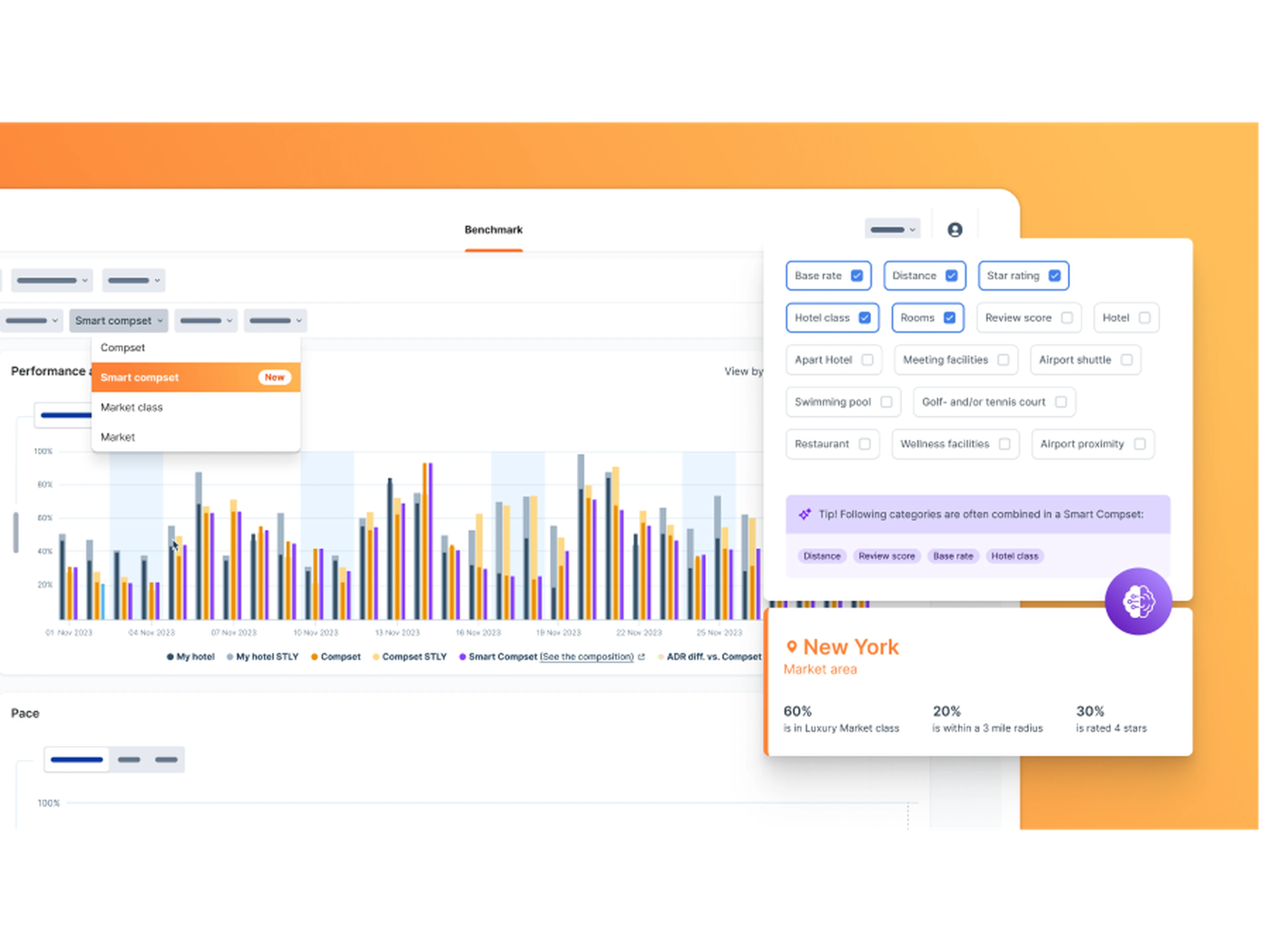
Traditional competitor sets are often built manually and remain static, even as booking behavior changes. Smart Compset, part of Lighthouse Performance, uses live search and booking data to show which hotels guests are actually comparing and booking against.
This forward-looking view updates dynamically, so revenue teams see their real competition by date, segment or market shift – not just the properties they traditionally track.
Smart Summaries
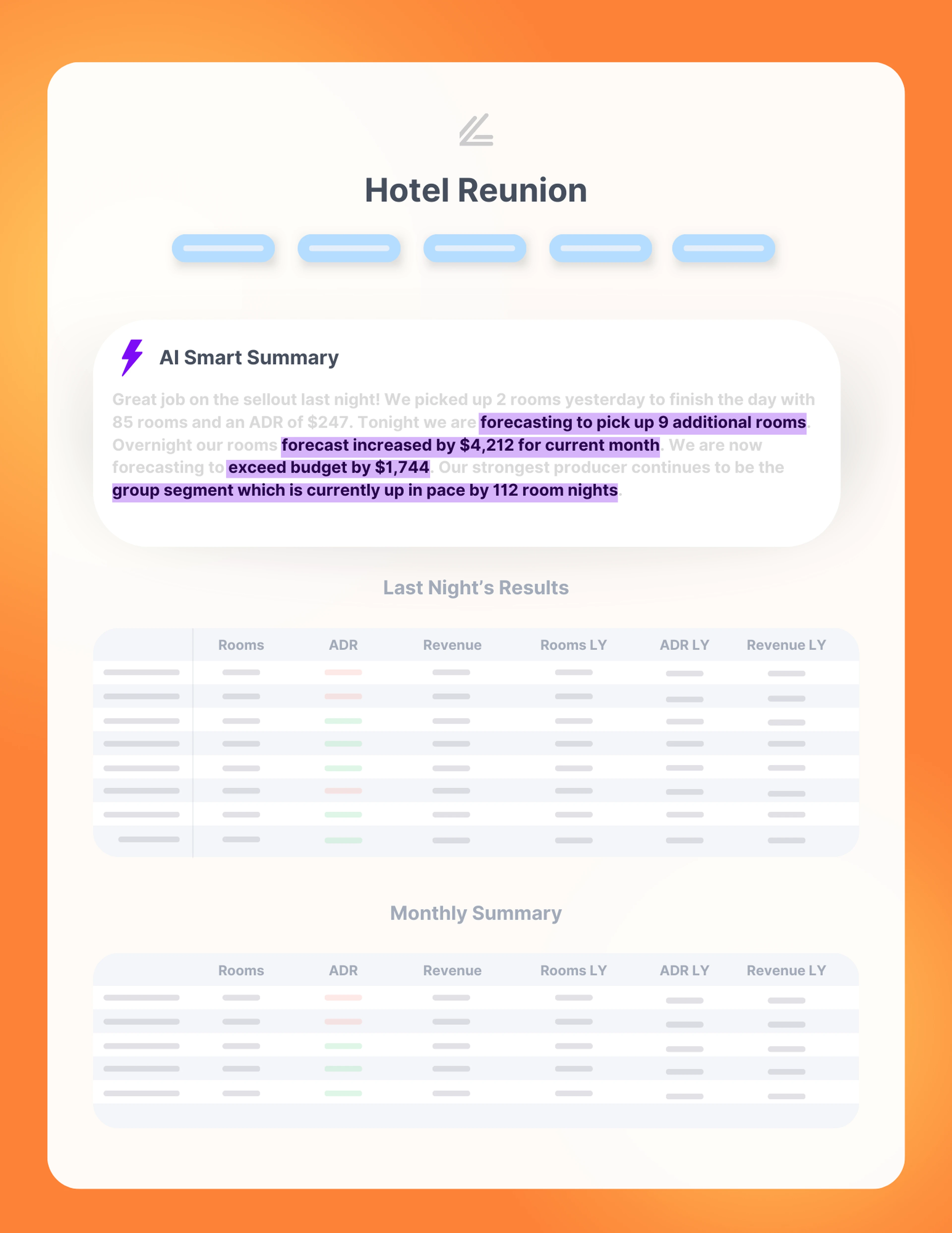
Reporting has long been one of the most repetitive tasks in revenue management. Smart Summaries turn Lighthouse data into daily natural-language reports, highlighting key pickup trends, performance shifts and portfolio metrics.
They arrive directly in a manager’s inbox each morning, reducing reporting time significantly and providing answers to many of the questions leadership will ask later in the day.
Forecasting and dashboards
Forecasting typically requires multiple spreadsheets and constant reconciliation against actuals. Revenue managers often have to manually spread monthly or weekly totals across individual days and segments, a time-consuming process that must be repeated whenever assumptions change.
Lighthouse Performance automates this work: forecasts for occupancy, ADR and revenue targets can be updated with bulk actions, while segments remain editable. Lighthouse dashboards are presentation-ready, reducing prep time from 90 minutes to 20 and ensuring stakeholders see consistent, accurate data.
Displacement analysis automation
When a group request arrives, revenue managers often spend half an hour or more compiling data across systems to decide whether to accept or reject it.
With Lighthouse Performance, metrics such as ADR, RevPAR, bookings and pace are brought into a single view, and Ernest’s Group Displacement skill starts the analysis from that data. Displacement analysis runs in minutes, allowing teams to evaluate group requests quickly and with confidence in complete, reliable data.
How do hotels stay visible in AI trip planning?
AI assistants such as ChatGPT, Gemini and Perplexity are becoming part of how travelers plan trips, and hotels with incomplete or outdated data risk being described inaccurately or missed.
Connect AI from Lighthouse structures hotel content, including descriptions, amenities, policies, rates and availability, so AI assistants can describe a hotel accurately and send travelers to its own booking engine
Shaping the future of hotel commercial strategy
Commercial teams have long been stretched between analysis and action. Too much time lost to spreadsheets and reporting, not enough spent on pricing, forecasting or aligning with sales and marketing. Lighthouse changes that by automating the repetitive work so teams can focus on what moves performance forward.
Smart Compset, Smart Summaries and forecasting already make that shift possible today. Ernest brings them together in one conversation, with skills like Group Displacement for the requests that used to take half an hour. Connect AI keeps hotels visible in the AI-driven channels where travelers now begin their journeys.
“Every organization sits somewhere different on the adoption curve,” says Greg. “What matters is running projects that can eventually become part of your core commercial strategy. Each experiment strengthens the next. Even if something doesn’t reach production, it builds the muscle for what comes next.”
For Lighthouse, innovation is a continuous process of testing, refining and scaling, always grounded in real hotel workflows, not abstract technology.
“We don’t add AI for the sake of it. Our goal is to make sure every capability – automated or not – saves time, improves clarity and helps hotels make better decisions.”
That pragmatic approach reflects why AI adoption isn’t just about the tools; it’s about trust. Teams who understand and trust the systems they use are faster, more aligned and better equipped to respond to change.
Some hotels are still testing AI on the side. Others are weaving it into daily work across their commercial teams. The ones taking that step are finding a clear advantage: more time for strategy, better collaboration and stronger results across the portfolio.
“Our focus is helping hotels turn data into action,” says Greg. “That’s where AI delivers real impact – when it frees people to think strategically, not just react.”
For Lighthouse, that means continuing to build tools that make every decision clearer and every hour count.
Frequently asked questions
How much time can AI save a hotel revenue manager?
In Lighthouse’s workday model, AI automation cuts on-the-books review from 45 to 20 minutes and meeting prep from 90 to 20, and moves strategy from 0% to 31% of the day. The model is a scenario from a Lighthouse whitepaper and does not report customer results.
Will AI replace revenue managers?
No. Ernest recommends what to do and links each answer to the Lighthouse data behind it, so the revenue manager makes the call.
What data does Ernest work from?
Ernest works from the Lighthouse data a hotel group already has: market rates and demand, performance and forecasts, and competitive set benchmarks. He only shows data that a customer’s Lighthouse subscription covers, and he links each answer back to its source.
How does Ernest help with group requests?
Ernest’s Group Displacement skill starts a group evaluation from Lighthouse Performance data, bringing ADR, RevPAR, bookings and pace into one view so the revenue manager can decide whether to accept the request.
How do hotels appear accurately in AI trip planning?
Lighthouse’s Connect AI structures hotel content, including descriptions, amenities, policies, rates and availability, in a format AI platforms can interpret. That lets assistants such as ChatGPT, Gemini and Perplexity recommend a hotel with up-to-date information.
Curious how Ernest and Lighthouse AI could help your hotel turn data into better decisions? Get in touch.

Joe Hanly

Joe Hanly
Joe Hanly is a writer and content creator at Lighthouse, helping hoteliers navigate industry trends with clear, engaging storytelling. He believes the best insights come from real experiences – that’s why when he’s not writing about travel and hospitality, he’s out exploring it firsthand. It’s all research. Sort of.